
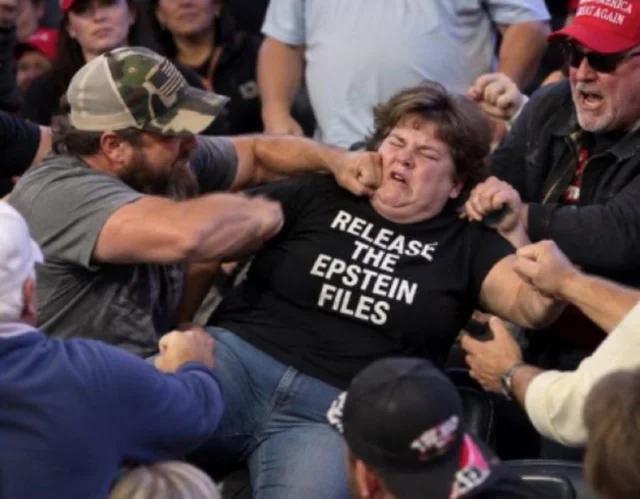
(Photo: Social Media)
YOUNGSTOWN, Ohio — October 13, 2026 — A woman wearing a “Release the Epstein Files” T-shirt was punched and shoved by attendees at President Donald Trump’s rally in Youngstown, Ohio, on Monday, October 12, in an incident that has raised questions about political violence, protester safety and the response of security personnel at political events.
Video footage from the rally at the Covelli Centre showed multiple men confronting the woman before one appeared to punch her repeatedly, pull her hair and place her in a headlock. Uniformed officers eventually escorted her from the venue, while Trump commented on the confrontation from the stage.
By Tuesday, the incident had drawn condemnation from Youngstown’s mayor, while local police were urging the woman to file a formal complaint so an investigation could proceed. No arrests had been announced in the reporting available at the time.
What Happened at the Youngstown Rally
The confrontation unfolded as Trump addressed supporters gathered in Youngstown to promote Republican candidates ahead of the November midterm elections.
Footage showed the woman standing and displaying a shirt calling for the release of additional records related to Jeffrey Epstein, the convicted sex offender who died in 2019. Several people nearby began confronting her, and the situation escalated into a physical altercation.
One attendee appeared to shove the woman before another man struck her in the face and pulled her hair. The footage showed officers approaching the group before the woman was escorted out of the arena.
The incident briefly interrupted the rally and drew attention away from Trump’s remarks. Video also captured members of the crowd chanting “USA” as the woman was removed.
The available footage documents portions of the confrontation, although it does not establish every detail of what occurred before the altercation began.
Trump Responds as the Confrontation Unfolds
As the incident continued, Trump characterized the protester as a paid demonstrator, claiming without presenting evidence that political opponents were paying people to disrupt his events.
He also made derogatory comments about the person’s appearance and weight while the confrontation was unfolding.
The remarks added another dimension to an incident already drawing scrutiny over the physical treatment of a protester inside a crowded political venue. The available reporting did not substantiate Trump’s allegation that the woman had been paid to attend the rally.
The woman’s shirt referenced the ongoing controversy surrounding the release of records connected to Epstein, whose associations with prominent individuals have continued to attract public attention and political debate.
The protest itself reflected a demand for greater transparency over those records. However, the available evidence does not establish the woman’s broader political affiliations or whether she was associated with any organized protest group.
Youngstown Police Call for a Formal Complaint
The police response has become a central question following the incident.
Youngstown police were not responsible for security at the rally. According to Mayor Derrick McDowell, security was handled by the Mahoning County Sheriff’s Office and the U.S. Secret Service.
Youngstown Police Lieutenant Frank Rutherford said Tuesday that his department was prepared to take a report and investigate if the woman filed a formal complaint.
“No one should be assaulted at an event,” Rutherford said in remarks reported by HuffPost. He added that someone who punches another person in the face should face consequences.
McDowell also condemned the confrontation, emphasizing that political disagreements should never justify physical violence.
“Regardless of someone’s political affiliation or their point of view, every person attending a public event has the right to do so without fear of being assaulted or threatened,” the mayor said in a statement.
Questions remain about the actions of security personnel during the altercation, including why the woman was escorted out while the apparent assailant was not immediately removed in the footage reviewed by news organizations. Authorities had not publicly established a complete account of those decisions.
At the time of reporting, officials had not announced criminal charges related to the incident.
Epstein Records Become Part of a Political Confrontation
The message on the woman’s shirt placed the confrontation within a wider political controversy over government records connected to Epstein.
Epstein, who faced federal sex-trafficking charges before his death in 2019, maintained connections with wealthy and influential individuals. The handling of records related to his activities has continued to generate public demands for disclosure and accountability.
Calls for the release of additional records have come from people across the political spectrum, making the issue a recurring subject of public scrutiny.
At the Youngstown rally, however, the debate over those records became secondary to the confrontation in the crowd.
The available reporting does not establish that the woman was targeted solely because of her shirt, nor does it provide evidence supporting the claim that she was paid to protest. Those questions remain distinct from what the footage appears to show: a protester being physically attacked during a political gathering.
A Great Lakes Community Confronts Political Violence
Youngstown sits in northeastern Ohio, within the broader Great Lakes region, where political events frequently bring together people with sharply differing views.
Public rallies are intended to provide a space for political expression, whether attendees support a candidate, oppose a policy or challenge a public figure. The safety of those gatherings depends on organizers and security personnel responding appropriately when confrontations occur.
The Youngstown incident has raised questions about whether protesters can safely express dissent at politically charged events and how authorities should respond when a disagreement becomes physical.
The mayor’s statement made clear that the issue extends beyond party affiliation. People attending public events should be able to express their views without facing violence, regardless of whether others agree with them.
The investigation, if formally initiated, will need to establish the conduct of those involved and determine whether criminal charges are warranted. Until then, the identities of the people involved and the legal consequences of the confrontation remain unresolved.
The Questions That Remain
The Youngstown rally has left several questions unanswered: whether the woman will file a formal complaint, whether investigators will identify the people seen attacking her, and whether authorities will bring charges.
The incident also leaves a broader question about the responsibilities of political leaders and event security personnel when violence occurs in front of a crowd.
Political disagreements are an ordinary part of democratic life. Physical attacks are not a legitimate substitute for argument, protest or debate.
For Youngstown, the significance of the incident extends beyond one rally or one political dispute. It is a reminder that the right to express dissent carries little meaning if people cannot exercise it safely.
The investigation’s outcome will determine whether the confrontation leads to legal accountability. For now, the central facts remain clear: a woman was physically attacked at a political rally, the president publicly mocked her, and local police called on her to file a complaint so the incident could be investigated.