
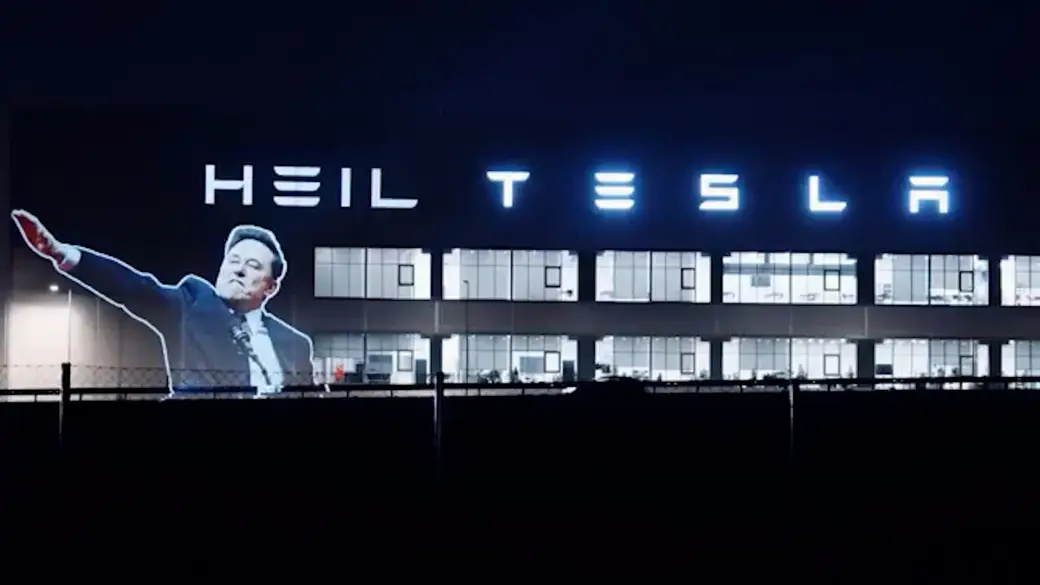
(Photo: An image of Elon Musk showing the controversial salute he made during a speech at a rally for Donald Trump was projected onto Tesla’s Gigafactory outside Berlin, alongside the words ‘Heil Tesla.’ The projection was carried out by the political activist groups Led by Donkeys and Political Beauty and was accompanied by a mini-doc, claiming Musk was using his wealth to promote ‘far-right parties’ in Europe. Global News)
Austin, TX — October 15, 2026 — Imagine spending years developing a car that can accelerate faster than almost anything on the road, drive upside down, and briefly launch itself into the air. Imagine assembling engineers, designers, and technicians to make something that sounds like a science-fiction fantasy. Imagine finally unveiling it to a crowd of spectators who can barely believe what they are watching.
Now imagine that the man standing at the center of this spectacle is Elon Musk, a billionaire who spent hundreds of millions of dollars helping elect Donald Trump in 2024 and has poured hundreds of millions more into the 2026 midterm elections. Imagine that this is also the same man whose inauguration-day gesture in January 2025 sparked international controversy after it was compared to a Nazi salute, and who has repeatedly used his enormous online platform to promote far-right political movements abroad.
Suddenly, the question surrounding Tesla’s new Roadster becomes considerably more complicated.
Is a spectacular car enough to make people forget the political influence of the person behind it? Does extraordinary engineering excuse the decisions of the billionaire funding it? And what responsibility, if any, belongs to the people who devote their time and expertise to turning his ambitions into reality?
The new Roadster is undeniably an extraordinary engineering project. Its unveiling featured compressed-air thrusters, inverted driving, dramatic aerial maneuvers, and acceleration claims that would have sounded absurd only a few years ago. Yet the spectacle should not distract from the larger question of what people are supporting when they celebrate Musk’s companies, purchase his products, and help transform his ideas into reality.
Because the issue is no longer simply whether Tesla can build an incredible car.
It is whether technological achievement should automatically earn its creator admiration, regardless of how that person uses his wealth, influence, and power.
The Man Behind the Machine
Elon Musk has spent years building a public image around technological ambition. Tesla promises to transform transportation. SpaceX promises to transform space travel. His other ventures pursue artificial intelligence, robotics, and ambitious visions of the future.
There is genuine engineering achievement behind many of these projects. Thousands of employees have contributed to products that have changed their industries, and it would be dishonest to pretend otherwise.
But Musk is not merely an executive who stays behind a desk while his companies develop new technology. He has deliberately made himself a political figure, using his personal fortune, social media platform, and enormous public profile to influence political debates and elections.
According to The Washington Post, Musk donated approximately $288 million during the 2024 election cycle, making him one of the most consequential financial supporters of Trump’s successful presidential campaign and other Republican candidates.
And the spending has not stopped.
Reuters reported on October 12, 2026, that Musk had spent approximately $366 million during the 2026 U.S. midterm election cycle, including roughly $276 million since July, primarily to help Republicans retain control of Congress.
These are not small donations from an ordinary citizen hoping to support a candidate whose policies he likes. They represent a level of financial influence that very few individuals can exercise over American elections.
Supporters will argue that Musk has every right to spend his money supporting candidates and policies he believes in. That is true. Political participation is not limited to people whose opinions are popular, and the right to support a candidate does not disappear because someone is wealthy.
But the existence of a legal right does not eliminate the need for public scrutiny.
When one billionaire can contribute hundreds of millions of dollars to political organizations, influence public debate through a platform he owns, and maintain enormous business interests affected by government decisions, it is reasonable to question how much influence one individual should have over the political future of millions of people.
That concern does not disappear because the same billionaire can build an impressive electric car.
The Gesture That Sparked International Outrage
On January 20, 2025, during a celebration surrounding Donald Trump’s presidential inauguration, Musk made a hand gesture that immediately attracted international attention.
After placing his hand against his chest, he extended his arm outward toward the audience. He then repeated a similar gesture toward another part of the crowd.
The movement prompted widespread comparisons to the Nazi salute, commonly associated with the phrase Sieg Heil and the regime responsible for the Holocaust and other atrocities committed by Nazi Germany.
Musk rejected the criticism, dismissing the accusations as political attacks. The Anti-Defamation League also stated that the gesture appeared to be an awkward expression of enthusiasm rather than a Nazi salute.
That distinction matters. The gesture’s meaning and Musk’s intentions remain disputed, and the incident alone does not establish that he is a Nazi.
But acknowledging that uncertainty does not require pretending the controversy never happened.
The gesture became part of a broader public debate about Musk’s political associations, his rhetoric, and his increasingly visible support for far-right figures and movements. It attracted attention not simply because of the movement itself, but because of the political environment in which it occurred.
For critics, the image raised an uncomfortable question about the direction of Musk’s public influence. For his defenders, the accusations were an example of opponents interpreting an ambiguous gesture in the worst possible light.
Reasonable people can disagree about the gesture’s precise meaning. What should not be controversial is the principle that a billionaire with Musk’s influence must be open to scrutiny.
The same scrutiny should apply when he uses his platform and wealth to shape political movements far beyond the United States.
From American Elections to Political Influence Abroad
Musk’s political involvement has not been confined to American elections.
In early 2025, he publicly endorsed Germany’s Alternative for Germany party, commonly known as AfD, and amplified its political message through his social media platform, X. He also became involved in British political controversies, publicly attacking political leaders and promoting arguments associated with the British far right.
The Associated Press reported in January 2025 that Musk’s interventions in European politics had alarmed politicians across the continent. In a subsequent investigation published in August 2025, AP examined how Musk’s interactions on X helped increase the visibility of several hard-right European politicians and activists.
This is an important distinction: using a social media platform to endorse a political party is not automatically illegal election interference. Nor does every endorsement prove that a foreign election’s outcome was changed.
The concern is the scale of the influence being exercised by a wealthy American who owns one of the world’s most influential social media platforms and can direct enormous attention toward political movements in other countries.
Democratic societies are built around the principle that their citizens should decide their political futures. Foreign voices can participate in public discussion, but the ability of a single individual to amplify favored movements, dominate attention, and inject enormous resources into political causes deserves serious examination.
Musk’s supporters may see this as free expression. His critics see a billionaire using unprecedented economic and technological power to promote an ideological agenda across borders.
Both the political endorsements and their consequences should be evaluated using evidence rather than assumptions. But the underlying concern is legitimate: technological wealth can become political power, and that power does not stop at national borders.
This is the context in which Tesla’s latest supercar has arrived.
The Roadster Is Impressive. That Is Not the Point.
There is no denying that the new Roadster makes for a remarkable demonstration.
Tesla unveiled the vehicle at an event near Waco, Texas, on October 15, 2026. The presentation featured a car driving upside down, launching over other Tesla vehicles, and briefly lifting into the air using compressed-air thrusters developed through collaboration with SpaceX.
The lineup includes four configurations, ranging from the Standard model to the extreme Rocket version.
The Standard Roadster is reported to produce approximately 1,073 horsepower, with a projected top speed of 210 mph. The Performance version is expected to deliver approximately 1,350 horsepower and reach 230 mph.
The Thrust version introduces four rear-mounted compressed-air nozzles, with Tesla claiming a 0–60 mph time of approximately 0.85 seconds. The single-seat Rocket configuration adds more thrusters and a larger pressurized-air supply, with an even more extreme claimed acceleration time of 0.59 seconds.
The car also features a carbon-fiber body, active aerodynamic components, a fan-assisted ground-effect system on the higher-performance configurations, and a reported range of approximately 300 miles.
Those are extraordinary ambitions, even if the most dramatic claims still need to be assessed against independently verified performance and the specifications of a finished production vehicle.
But what exactly are we supposed to conclude from them?
That Musk is a brilliant showman? That Tesla engineers can develop remarkable technology? That electric vehicles can be pushed beyond the limits of conventional automotive design?
All three may be reasonable conclusions.
None answers the question of whether the political power Musk has accumulated should be treated as irrelevant whenever he produces something impressive.
A car does not become a moral argument in its creator’s favor simply because it can fly.
Who Is Actually Building This Car?
One of the most important details about the Roadster is that Musk is not building it alone.
Tesla’s employees, designers, engineers, manufacturing specialists, software developers, and technicians are the people who perform the work necessary to turn a concept into a functioning vehicle. The project also draws on engineering collaboration between Tesla and SpaceX.
Their technical contributions deserve to be understood on their own merits. It would be unfair to suggest that every engineer who works on an electric vehicle necessarily shares the political views of the company’s chief executive.
People work for companies for many reasons: employment, financial security, professional ambition, genuine interest in the technology, or the opportunity to solve difficult engineering problems.
An engineer who develops an aerodynamic system is not automatically endorsing the political positions of the person who ultimately benefits from the product. Nor does an employee’s participation establish that they approve of every action taken by the company’s leadership.
But the other side of the question deserves attention too.
Companies do not operate independently of the people who control them. Their products generate revenue, strengthen their public image, attract customers, and reinforce their position in the marketplace. Successful launches can increase a company’s visibility and make its leadership appear more credible and influential.
The Roadster is therefore not merely a technical project. It is also a Tesla product, a SpaceX collaboration, and a highly public demonstration of Musk’s technological ambitions.
That does not make every employee personally responsible for Musk’s politics. It does mean that people who choose to work for, promote, invest in, or purchase from his companies can reasonably consider the broader consequences of that support.
The distinction is between assigning personal guilt to every worker and recognizing that economic participation can help sustain an institution whose leadership exercises significant political influence.
Those are not the same thing.
A Car That May Never Be Usable as Demonstrated
There is another reason to be cautious about treating the Roadster announcement as a definitive triumph: the difference between demonstrating a prototype and delivering a practical production vehicle.
The Rocket configuration’s ability to lift off the ground is perhaps the most spectacular feature of the entire project. It is also the feature that raises some of the most serious practical questions.
A car capable of brief, controlled airborne maneuvers is not automatically a practical flying vehicle. Such a system must contend with stability, landing forces, passenger protection, mechanical reliability, and regulatory requirements.
The Rocket configuration, as demonstrated, is not a conventional road-legal vehicle. Its extraordinary propulsion system raises questions about what would be permitted on public roads and under what conditions. The fact that a prototype can perform a maneuver at a controlled event does not establish that the same maneuver can legally or safely be performed in ordinary traffic.
And even without the thrusters, the Roadster has a long history to overcome.
Tesla first unveiled the second-generation Roadster concept in 2017, initially promising a vehicle that would deliver extraordinary acceleration and long-distance range. Over subsequent years, its anticipated launch was repeatedly postponed.
The company has now presented a substantially reworked design and a new set of ambitious claims. According to reporting by TechCrunch, Tesla is targeting production in 2028, but the final pricing and delivery details remain uncertain.
The new announcement is a significant milestone, but it is not the same as having a fully validated, commercially available vehicle in customers’ driveways.
That matters because Musk has repeatedly attracted attention through bold promises. Some of his companies’ projects have delivered major technological achievements, while others have encountered substantial delays, changed scope, or failed to meet their original ambitions.
The Roadster must ultimately be judged by what Tesla delivers, not only by what its chief executive promises onstage.
The Cult of the Technological Genius
Modern technology culture has developed an unhealthy tendency to treat exceptional engineering as a substitute for examining the people who control it.
A billionaire announces a revolutionary product, and the discussion quickly becomes a celebration of individual genius. The engineers who contributed to the work become supporting characters in a story about one extraordinary man. His controversies are pushed into the background while the latest demonstration takes center stage.
Musk has benefited enormously from this dynamic.
His public image combines the roles of engineer, entrepreneur, futurist, and political provocateur. The same person who presents a vehicle capable of spectacular stunts also commands a major social media platform, directs enormous political donations, and uses his public profile to promote political movements.
For admirers, those activities may be separate parts of a complicated public life. For critics, they form a larger picture of a billionaire who has accumulated more influence than any one individual should comfortably exercise.
The Roadster will inevitably generate excitement among car enthusiasts. Its performance claims will invite comparisons with conventional supercars, and its thrusters will produce endless videos and headlines.
But the spectacle can also serve as a distraction. For a moment, the conversation shifts away from political spending, the influence of private wealth, and the consequences of Musk’s interventions in public life.
Suddenly, everyone is discussing acceleration times rather than the concentration of political power.
That is not necessarily a deliberate strategy behind the launch, and there is no need to invent one. It is simply a familiar feature of celebrity culture: a spectacular new project can dominate public attention even when the person presenting it remains deeply controversial.
The appropriate response is not to deny the engineering achievement. It is to refuse to let the engineering achievement end the conversation.
You Can Admire the Engineering Without Excusing the Politics
There is no contradiction in acknowledging that Tesla’s engineers have produced impressive work while criticizing Musk’s political behavior.
A person can recognize the achievement represented by an electric vehicle capable of extraordinary acceleration without supporting its chief executive’s political spending. A car enthusiast can appreciate the Roadster’s design while questioning Musk’s influence over elections. An engineer can respect the technical challenge without sharing the ideological commitments of the person funding the project.
These distinctions matter because arguments about technology often become unnecessarily personal. Criticism of Musk is treated as hostility toward engineers, electric vehicles, or innovation itself.
But none of those things is interchangeable.
Electric vehicles can be valuable without Musk being treated as infallible. Space exploration can be worthwhile without every SpaceX project being celebrated uncritically. Engineering innovation can be encouraged without granting billionaires immunity from public scrutiny.
The same principle applies to the people who buy the Roadster.
Purchasing a product does not automatically mean endorsing everything its CEO believes. But consumers are also entitled to decide that a company’s leadership, political spending, or public behavior makes them unwilling to provide financial support.
That is a personal decision, not a test of whether someone is a good engineer or a legitimate car enthusiast.
The point is not to demand that every person who works for or purchases from Tesla share a single political position. It is to insist that the political consequences of concentrated wealth remain part of the discussion, even when the product in question is genuinely exciting.
What Are We Actually Celebrating?
The Roadster’s unveiling offers an almost perfect illustration of the tension between technological achievement and political responsibility.
On one side is a vehicle with extraordinary engineering ambitions: active aerodynamics, high-power electric propulsion, compressed-air thrusters, and the ability to perform controlled airborne maneuvers.
On the other is the billionaire whose public influence extends well beyond the automotive industry, including hundreds of millions of dollars in political spending and interventions in political debates across multiple countries.
Neither side cancels out the other.
The Roadster’s technology does not erase Musk’s political activities. His political activities do not erase the technical work performed by Tesla and SpaceX employees.
Both deserve to be examined honestly.
The more difficult question is what kind of public culture we want to create around powerful people. Should spectacular products earn their creators an automatic presumption of admiration? Should technological achievement be treated as evidence of broader wisdom or good judgment? Or should we be capable of recognizing extraordinary work while remaining critical of the institutions and individuals responsible for it?
A functioning democracy requires the last of those approaches.
People should be free to admire a machine without turning its creator into a hero. They should be able to appreciate engineering without ignoring the consequences of political influence. And they should be able to question a billionaire’s actions without being accused of opposing technological progress.
The Roadster may eventually become a remarkable production car. It may even deliver some of the most extraordinary performance figures ever achieved by an electric vehicle.
But those achievements will not settle the questions surrounding Musk’s political influence, his election spending, or the responsibilities that come with controlling enormous private wealth.
The car is not the whole story.
The Future Should Be About More Than One Billionaire
There is something deeply revealing about a society that can become captivated by a car capable of briefly leaving the ground while struggling to maintain the same level of attention toward the political power of the man presenting it.
The Roadster is designed to provoke astonishment. Its dramatic demonstrations, extreme acceleration claims, and aerospace-inspired technology practically guarantee attention.
But astonishment is not the same as judgment.
The people who worked on the Roadster may have solved difficult engineering problems. Tesla and SpaceX may have demonstrated capabilities that deserve serious technical attention. If the production vehicle eventually delivers on its promises, that achievement should be acknowledged.
None of this requires treating Musk as a political role model, overlooking the controversy surrounding his January 2025 gesture, or dismissing concerns about his influence over elections in the United States and abroad.
Nor does it require declaring every person involved in the vehicle personally responsible for the decisions of its chief executive.
The more meaningful question is whether society can separate technological achievement from the cult of personality that often surrounds it.
A billionaire’s fortune should not automatically translate into political authority. A spectacular product should not serve as a substitute for accountability. And a person’s ability to build something extraordinary should not place their other actions beyond criticism.
The Tesla Roadster may be able to fly. It may accelerate faster than almost any conventional production car. It may become a defining engineering achievement if its most ambitious features survive the transition from demonstration to retail.
But none of that changes the fundamental question.
We can celebrate what engineers are capable of creating without surrendering our judgment about the people who control the companies they work for.
And no matter how spectacular the machine becomes, the political influence of the billionaire behind it remains a subject worth examining.