
(Photo: Social Media)
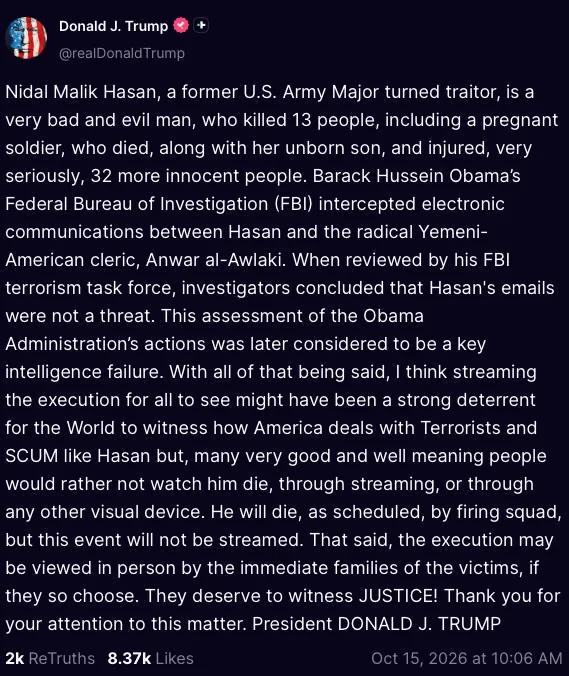
WASHINGTON, D.C. — October 15, 2026 — President Donald Trump has abandoned a controversial plan to livestream the scheduled execution of Nidal Malik Hasan, reversing a proposal announced by Defense Secretary Pete Hegseth that would have broadcast the execution of the former Army psychiatrist convicted in the 2009 Fort Hood shooting. But while the administration has stepped back from televising the execution, the original proposal raises questions about the role of fear, public spectacle and intimidation in the exercise of government power.
Hasan was convicted of killing 13 people and attempting to kill 32 others at Fort Hood, Texas, in 2009. His execution by firing squad had been scheduled for December 3, 2026, although legal challenges could affect that timeline. Hegseth’s proposal to broadcast the execution drew criticism from political figures, religious leaders and others concerned about the prospect of turning a state execution into a public spectacle. Trump announced Thursday that the livestream would not proceed.
Trump Backs Away From the Broadcast
Trump acknowledged that publicly televising the execution might serve as a deterrent but said he recognized that many Americans were uncomfortable with broadcasting such an event. His decision overturned Hegseth’s earlier announcement and marked a retreat from one of the administration’s most controversial proposals surrounding capital punishment.
The reversal matters. Broadcasting an execution would represent a significant departure from the established boundaries surrounding how the government carries out and presents capital punishment to the public. The decision to abandon the livestream avoids that particular escalation.
But the controversy should not end with the reversal.
The Original Proposal Deserves Scrutiny
A change of position does not erase the significance of the policy initially proposed. The question is not simply whether the administration ultimately decided against a livestream, but why the possibility of publicly broadcasting an execution was put forward in the first place.
The idea of televising an execution as a deterrent places the suffering and death of a condemned person within a broader political message. It turns a punishment carried out by the state into a potential demonstration of its power, inviting the public to watch as a warning to others.
There is a fundamental distinction between carrying out a lawful sentence and using the spectacle of that sentence to communicate authority through fear.
The victims of the Fort Hood attack and their families remain central to this story. Their loss should not be reduced to a political prop, and the gravity of Hasan’s crimes does not eliminate the need to scrutinize how the government chooses to exercise its power.
Intimidation Does Not Require Follow-Through
Political intimidation is not limited to threats that are ultimately carried out. A threat can shape public expectations, dominate a news cycle and establish what a government is willing to contemplate, even when the proposal is later withdrawn.
That does not, by itself, prove that Trump’s original motive was to intimidate political opponents or the general public. Establishing motive requires evidence. But the administration’s willingness to consider broadcasting an execution as a deterrent raises legitimate questions about the use of fear as a governing instrument.
The distinction between a threat and its execution is important, but so is the distinction between abandoning a proposal and rejecting the thinking behind it.
If the administration believes the broadcast would have been inappropriate, the public deserves to know whether that judgment reflects a broader objection to turning executions into spectacles or simply a decision that the political and public costs were too high.
A Reversal Is Not the Same as Accountability
The cancellation of the livestream is a meaningful change in policy. It should not, however, become a reason to forget that the proposal was made.
A government demonstrates its character not only through the actions it ultimately takes, but also through the measures it considers, the limits it tests and the justifications it offers for exercising its authority.
The execution itself remains a separate legal matter, subject to the applicable procedures and any outstanding challenges. The decision not to broadcast it resolves one controversy, but it does not answer every question raised by the original plan.
The larger issue is whether the government treats the use of state power as a matter of justice and lawful procedure or as an opportunity to demonstrate dominance through public fear.
Trump has backed away from the livestream. The public debate over why the administration considered it in the first place should continue.