
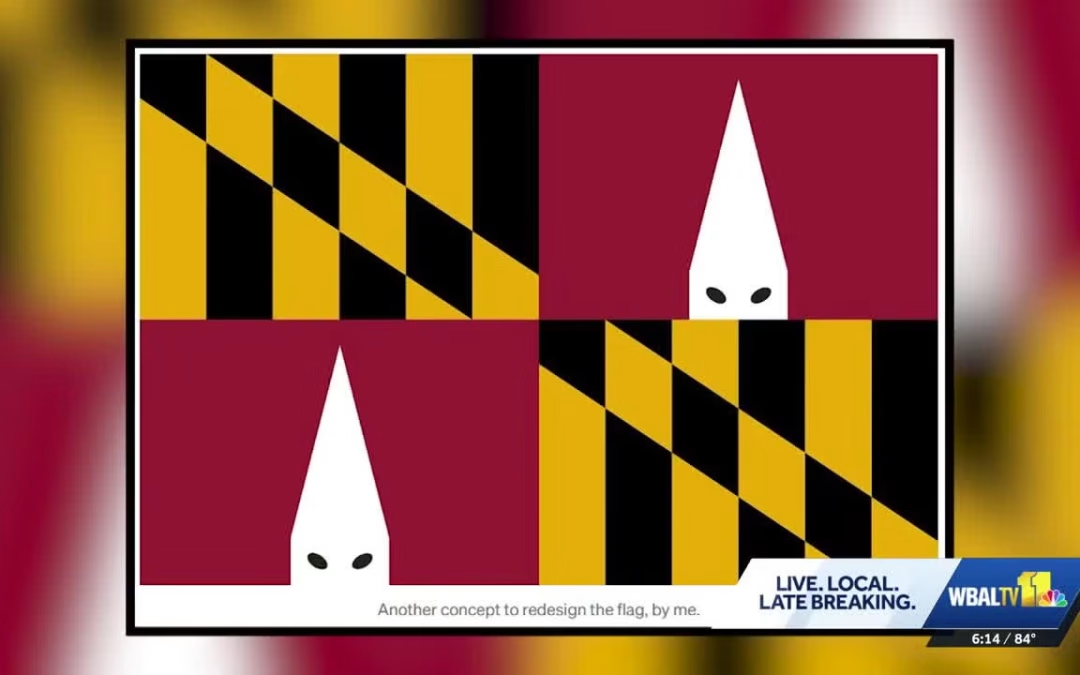
(Photo: WBAL)
COLLEGE PARK, Maryland — October 13, 2026 — The University of Maryland has indefinitely suspended its club tennis team after racist imagery depicting Ku Klux Klan-style hoods appeared in materials distributed to other universities ahead of a collegiate tournament, prompting investigations, apologies and renewed questions about racism and accountability in college athletics.
The image, which altered the Maryland state flag to incorporate imagery associated with the white supremacist Ku Klux Klan, was discovered by Toni Rachal, president of Howard University’s club tennis team, while reviewing tournament materials shared with participating schools. Howard, a historically Black university in Washington, D.C., was among the teams invited to compete in the event at Maryland’s College Park campus.
The incident has since prompted condemnation from university leaders and calls for stronger accountability from Howard’s athletes. Maryland officials have referred the matter to campus police and the university’s Office of Student Conduct, while the entire club tennis team has been suspended indefinitely pending an investigation.
The controversy has transformed what was supposed to be a collegiate sporting event into a broader discussion about racism, the safety of Black students and whether universities are doing enough to prevent racist conduct within their own organizations.
Racist Imagery Discovered Ahead of Tournament
The controversy emerged in the days leading up to a fall club tennis tournament hosted by the University of Maryland.
Tournament organizers had distributed materials containing schedules and other information to participating university tennis clubs. While reviewing the shared documents, Rachal discovered a graphic featuring Maryland’s state flag altered with imagery resembling Ku Klux Klan hoods.
The Klan is a white supremacist organization with a long history of racial terror, including lynchings, intimidation and violence directed primarily against Black Americans. Its distinctive white hoods have become among the most recognizable symbols of organized racist intimidation in the United States.
For Howard’s players, the discovery was particularly troubling because they were preparing to travel to a tournament hosted by another university, expecting to participate in a sporting competition rather than confront imagery associated with racial violence.
Rachal brought the image to attention, prompting a response from Maryland officials and the removal of the material.
As of October 13, the university had not publicly established who created the graphic or why it was included in the tournament materials. Those questions remain central to the investigation.
The university’s response also did not establish that every member of the tennis team had participated in creating or distributing the image. Officials acknowledged that the incident may have directly involved only a small number of students, while imposing a suspension on the team as a whole.
Maryland Suspends the Entire Club Tennis Team
The University of Maryland’s Recreation and Wellness department suspended its club tennis team indefinitely while the Office of Student Conduct investigates.
The university also referred the matter to the University of Maryland Police Department. Its Office of Civil Rights and Sexual Misconduct is conducting a separate review.
The team forfeited its matches in the tournament, although competition continued for the other participating schools.
Maryland’s club tennis student leaders met with captains of other teams to acknowledge the incident and apologize. They also sent apology emails to the participating programs.
University President Darryll J. Pines issued a message to the campus community on October 13, condemning the imagery and apologizing for the harm it caused.
Pines acknowledged the impact on Black students, members of Howard’s tennis team and Black athletes within Maryland’s own club tennis program.
He also said the university intended to work with campus organizations and provide cultural sensitivity training to members of the suspended team.
The university’s response represents an attempt to address the immediate harm while determining how the incident occurred. However, the suspension and apologies have not ended the debate over what further consequences should follow.
Howard Students Say an Apology Is Not Enough
For Howard’s tennis players, the issue extends beyond removing an offensive image from a shared document.
Rachal and other team members have called for stronger accountability, including a formal public apology, additional education about racism and a donation of tournament funds to the National Museum of African American History and Culture.
Students have also questioned why safeguards were not sufficient to prevent racist imagery from appearing in materials distributed to visiting teams.
Their concerns reflect the position that universities should not rely solely on apologies after incidents involving racial hostility. Instead, institutions must establish procedures that reduce the likelihood of similar incidents and demonstrate that complaints from affected students are taken seriously.
Howard’s athletes were placed in the position of confronting the material, raising concerns and seeking a response from the host institution.
That responsibility can carry an additional emotional burden for students who already navigate racial discrimination in academic, athletic and social settings.
The incident has also drawn attention to the distinction between acknowledging harm and repairing it. An apology may communicate regret, but affected students may also seek transparency, education and measures intended to prevent a recurrence.
Those demands place pressure on Maryland to demonstrate that its response will extend beyond the immediate suspension.
Racism in College Athletics Remains a Concern
College sports bring together students from different backgrounds and institutions, creating opportunities for competition, friendship and shared experiences.
But athletic organizations are not insulated from the broader racial tensions that exist within American society.
Racist imagery can communicate exclusion even when it is presented without a direct verbal threat. When such imagery appears in materials connected to an organized university event, it raises questions about the environment students are expected to enter and the standards governing the organizations representing their institutions.
The history associated with Klan imagery makes the incident especially serious. The symbol is not simply an offensive graphic detached from history; it evokes a movement responsible for generations of racial intimidation and violence.
The circumstances surrounding the image’s creation and distribution remain under investigation, and the available evidence does not establish the intentions of every person involved. Nevertheless, the impact on participating students and the university’s responsibility to respond are matters that can be addressed independently of those unresolved questions.
Universities have obligations to establish clear expectations for student organizations and to investigate credible reports of misconduct. They also have a responsibility to ensure that disciplinary decisions are based on evidence and that students are not assumed to have participated in wrongdoing merely because they belong to the same organization.
Maryland’s investigation will need to establish individual responsibility while determining what organizational failures, if any, contributed to the incident.
A Test of Institutional Accountability
The University of Maryland’s response has included a team suspension, administrative investigations, an apology from its president and plans for cultural sensitivity training.
Those actions establish an initial response, but the investigation’s findings and the measures that follow will determine whether the university can address the concerns raised by Howard’s athletes.
Important questions remain unanswered, including who created the image, who distributed it and whether additional disciplinary measures will be imposed.
Howard’s players have made clear that they want more than expressions of regret. Their demands place the emphasis on meaningful accountability and on ensuring that students who encounter racist conduct are not left to carry the burden of seeking change themselves.
For Maryland, the challenge is to establish the facts, hold responsible individuals accountable where warranted and demonstrate that the university’s stated opposition to racism is reflected in its institutional practices.
For the wider college athletics community, the incident serves as a reminder that sporting competition does not exist separately from the social environments in which it takes place.
A tournament can continue after a team forfeits its matches, but the questions raised by racist imagery do not disappear when the competition ends.
The investigation will determine what happened and who was responsible. The more lasting measure of the university’s response will be whether its actions help ensure that students can participate in college athletics without confronting symbols of racial intimidation in the very spaces intended to bring them together.