
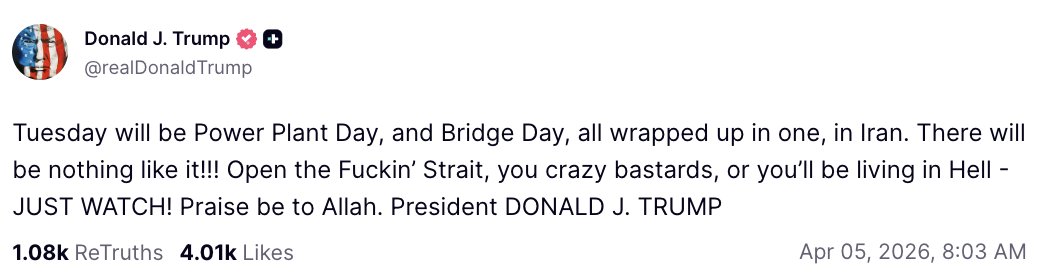
(Photo: Truth Social)
Washington D. C., USA — April 5, 2026
This morning, as people wake up to Easter—a day that’s supposed to be about reflection, renewal, and, at the very least, a bit of peace—Donald Trump has instead injected something else entirely into the moment: a public, profanity-laced threat of military destruction aimed at Iran.
It’s hard to overstate how abnormal this is.
The post, published on Truth Social, reads less like a statement from a national leader and more like something written in the heat of impulse. It openly threatens to target infrastructure—power plants, bridges—and does so in a tone that is erratic, theatrical, and deeply unsettling. At one point, it even frames potential military action like a scheduled event.
This is not how serious people communicate about war.
This Isn’t Strength — It’s Instability
There’s a difference between projecting force and losing control of the message. World leaders are expected to be measured, even when they are being tough. Especially then.
What we’re seeing here doesn’t come across as calculated pressure or strategic signaling. It feels reactive. Improvised. Unfiltered.
And when the subject is something as consequential as military action, that lack of discipline isn’t just inappropriate—it’s dangerous.
The Timing Makes It Worse
That this was posted on Easter morning is not a small detail.
Today is one of the most significant days in the Christian calendar. It’s meant to symbolize hope, restraint, and renewal. Instead, the day has been punctured by rhetoric about destruction, threats, and escalation.
Adding religious language at the end of a message like this doesn’t make it meaningful—it makes it more jarring. The contrast is so stark it borders on surreal.
A Baseline We Shouldn’t Have to Defend
There’s a basic standard that should apply here, regardless of politics:
No one with influence over military power should be speaking like this. Not publicly. Not casually. Not ever.
This isn’t about policy differences or partisan disagreement. It’s about whether the tone and behavior on display meet even the minimum expectations of leadership.
Right now, they don’t.
What This Says About Where We Are
If a message like this starts to feel routine—if people shrug and move on—that’s its own kind of problem. Because it means the line for what counts as alarming has already moved.
And it shouldn’t.
Because if threats of war start sounding like social media content, we’ve already lost something important.
Final Thought
It’s Easter morning. It should feel quiet, reflective—maybe even hopeful.
Instead, we’re parsing a post that reads like a threat dressed up as a rant.
That alone should tell us something isn’t right.