
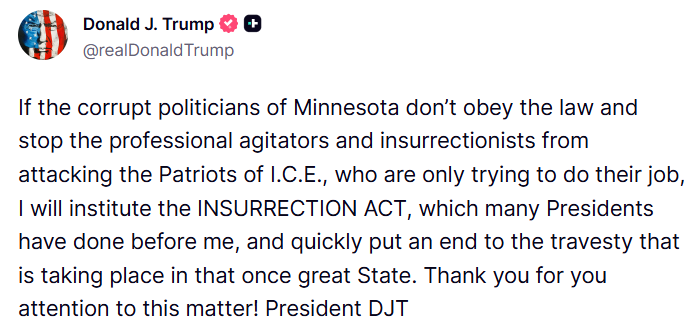
(Photo: Truth Social)
Minneapolis, MN — January 15, 2026
President Donald Trump escalated tensions in Minnesota today with a Truth Social post threatening to invoke the Insurrection Act, citing unrest in Minneapolis as federal immigration enforcement operations continue to expand across the state.
The post was made just hours after renewed protests in Minneapolis and amid growing scrutiny of a federal law-enforcement surge that has brought nearly 3,000 ICE and DHS agents into Minnesota — a presence that now rivals or exceeds the size of local police forces.
Trump’s Truth Social Threat
In the post, Trump directly warned Minnesota officials that federal intervention could follow if unrest continues. He wrote:
“If the corrupt politicians of Minnesota don’t obey the law and stop the professional agitators and insurrectionists from attacking the Patriots of I.C.E., who are only trying to do their job, I will institute the INSURRECTION ACT, which many Presidents have done before me, and quickly put an end to the travesty that is taking place in that once great State. Thank you for you attention to this matter! President DJT.”
While Trump has not formally invoked the Insurrection Act, the public threat represents a significant escalation and places Minneapolis at the center of a national debate over federal authority, immigration enforcement, and the domestic use of extraordinary executive power.
Scale of Federal Enforcement in Minnesota
The threat comes as Minnesota experiences one of the largest federal immigration enforcement surges in recent history.
According to reporting by the Star Tribune, approximately 2,000 federal agents are already operating in the Minneapolis–St. Paul area, with an additional 1,000 ICE and CBP officers expected, bringing the total to about 3,000 federal agents statewide.
If fully deployed, that force would:
-
Exceed the combined sworn officers of the 10 largest Twin Cities police agencies
-
Be nearly five times the size of the Minneapolis Police Department
-
Represent one of the largest concentrations of federal immigration officers in a single metropolitan area
Local officials say the scale of the deployment has strained city resources and complicated public safety operations.
Shootings and Protests Preceding the Post
Trump’s Truth Social post follows a series of high-profile incidents involving federal officers in Minneapolis, including:
-
The fatal shooting of Renée Nicole Good by a federal immigration officer earlier this month
-
A separate incident this week in north Minneapolis, where a federal officer shot a man in the leg during an enforcement action, according to the Department of Homeland Security
Both incidents sparked protests and confrontations between demonstrators and law enforcement. Federal authorities have described the shootings as acts of self-defense, while city leaders and community members have called for independent investigations and greater transparency.
Protests following the most recent shooting led to the use of tear gas and crowd-control tactics by law enforcement, further intensifying public distrust and unrest.
State and Local Officials Push Back
Minnesota Governor Tim Walz and Minneapolis Mayor Jacob Frey have criticized the federal response, arguing that the surge:
-
Undermines local authority
-
Forces city police to manage unrest tied to federal actions
-
Escalates tensions rather than stabilizing the situation
Minneapolis police officials report thousands of overtime hours responding to incidents related to federal operations, despite not directing those enforcement efforts.
Civil rights organizations have also filed lawsuits alleging that federal enforcement disproportionately targets immigrant and minority communities and violates constitutional protections.
A Constitutional Flashpoint
Trump’s public threat to invoke the Insurrection Act places Minneapolis at the center of a broader constitutional and political conflict over:
-
Federal versus state authority
-
The domestic use of military or quasi-military force
-
The limits of immigration enforcement during civil unrest
Legal experts note that while the Insurrection Act grants broad presidential power, its use is historically rare and politically volatile — particularly when state governments oppose federal intervention.
What Comes Next
As of today, the Insurrection Act has not been formally invoked. However, the combination of:
-
A massive federal law-enforcement presence
-
Ongoing protests
-
Active litigation
-
And a presidential threat issued just hours ago
has left Minneapolis in a state of heightened uncertainty.
Whether tensions ease or escalate may depend on federal decisions in the coming days — and whether the administration chooses de-escalation or further expansion of its authority.