
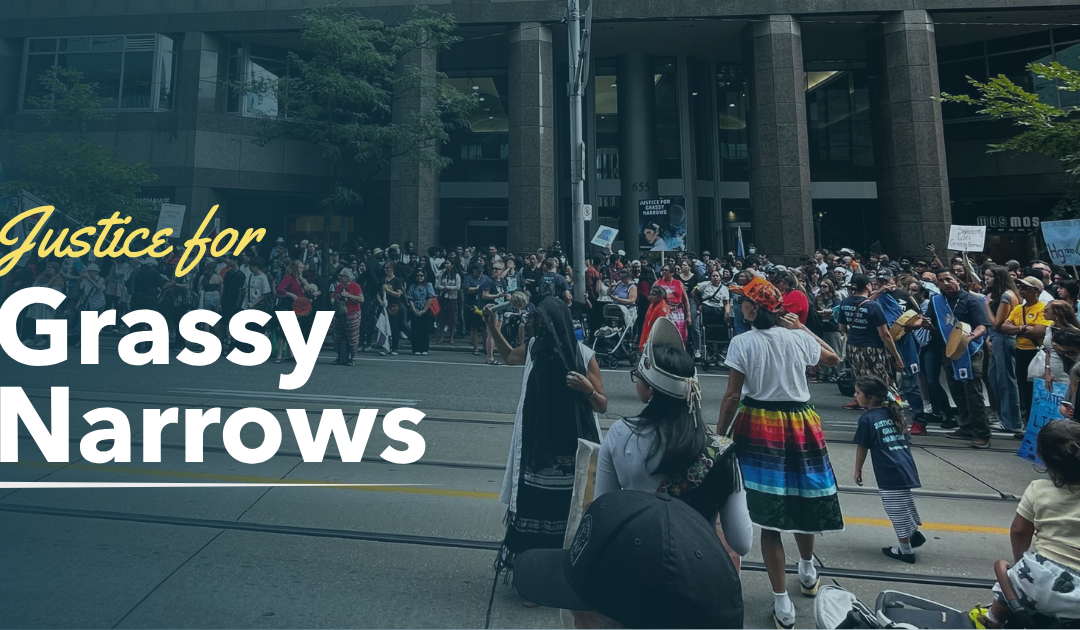
(Photo: Social Media)
TORONTO, Ontario — September 23, 2026 — Thousands of demonstrators marched through downtown Toronto on Wednesday to demand justice for Grassy Narrows First Nation, a northwestern Ontario Indigenous community that has endured decades of mercury contamination and its devastating effects on public health, traditional livelihoods and community life.
The demonstrators gathered at Grange Park before marching toward Queen’s Park, calling on Ontario Premier Doug Ford and Canadian Prime Minister Mark Carney to take stronger action to address the continuing crisis. The rally brought together members of Grassy Narrows, Indigenous rights advocates, labour organizations, environmental groups and other supporters demanding accountability for the contamination of the English-Wabigoon River system.
Mercury was discharged into the river system by a pulp and paper mill near Dryden, Ontario, during the 1960s and 1970s. Although the original industrial discharges occurred decades ago, the consequences have continued to affect Grassy Narrows, where mercury exposure has damaged health, disrupted fishing traditions and left generations of residents seeking meaningful compensation and environmental restoration.
The demonstration was not simply a protest over a historical pollution incident. It was a demand for governments to address the continuing consequences of an environmental disaster that community members say has never been adequately resolved.
A Crisis That Has Lasted for Generations
Grassy Narrows First Nation, also known as Asubpeeschoseewagong Netum Anishinabek, is an Ojibwe community in northwestern Ontario.
The community’s relationship with the English-Wabigoon River system has long been central to its way of life. Fishing has provided food, supported livelihoods and formed part of the cultural traditions passed between generations.
That relationship was severely damaged after industrial mercury contamination entered the waterways in the 1960s and 1970s.
Mercury can be transformed by environmental processes into methylmercury, a highly toxic compound that accumulates in fish and can enter the human body through consumption. Exposure can damage the nervous system and cause a range of neurological and other health problems.
For people whose diets and livelihoods depend on fish, contamination can have consequences extending far beyond the immediate environment. Avoiding contaminated fish may reduce exposure, but it can also disrupt food security, traditional practices and economic independence.
The crisis has therefore affected more than the health of individual residents. It has undermined a relationship between the community and its surrounding environment that has existed for generations.
For Grassy Narrows, restoring the river system is inseparable from restoring community well-being.
Thousands Demand Action at Queen’s Park
Wednesday’s march brought the community’s demands into the heart of Ontario’s provincial government.
Participants called for stronger action to address mercury contamination, fair compensation for affected residents and an end to industrial activities they believe continue to threaten their community.
Toronto police estimated the crowd at approximately 2,000 people, while organizers and supporters described a substantially larger turnout. Estimates of protest attendance can vary depending on the methods used and the movement of people throughout an event.
The demonstration reflected years of frustration among Grassy Narrows residents and their supporters, many of whom argue that government commitments have not translated into a complete resolution of the crisis.
For participants, the march was an opportunity to make clear that the passage of time has not erased the consequences of the contamination.
Community members have continued to describe the physical, emotional and economic burdens associated with mercury exposure. Families have also raised concerns about the effects on younger generations and the loss of relatives whose lives were shaped by the crisis.
The presence of supporters from labour organizations, environmental groups and other communities demonstrated how the issue has become part of a broader debate over environmental justice and the responsibilities governments and industries have toward communities harmed by pollution.
The Demands Go Beyond Cleanup
Grassy Narrows and its supporters are calling for more than a promise to address contamination in the river.
Their demands include fair compensation for people affected by mercury poisoning, meaningful restoration of the English-Wabigoon River system and action against industrial pollution that they say continues to threaten the community.
The demands also include shutting down the Dryden mill, which activists argue remains part of a wider environmental threat to the area. Such demands raise difficult questions about industrial responsibility, employment and the obligations of governments to protect both communities and the environment.
For Grassy Narrows, however, the central concern is that the community should not have to continue bearing the consequences of industrial activity while waiting for a comprehensive solution.
Compensation is an important part of the debate because environmental damage can impose costs that extend across a person’s lifetime. Medical needs, lost economic opportunities and the disruption of traditional food systems can all create burdens that are difficult to measure through a single payment or program.
Environmental restoration is similarly complex. Removing or reducing pollution in a river system can require sustained scientific work, monitoring and cooperation among governments, industries and affected communities.
Even when a source of contamination is addressed, mercury can remain in sediments and food webs for extended periods. That means the effects of historic pollution can persist long after the original discharge has ended.
The demands heard in Toronto reflect the community’s insistence that resolving the crisis requires attention to all of these consequences.
Indigenous Rights and Environmental Accountability
The Grassy Narrows crisis has become a powerful example of the long-term consequences of environmental harm affecting Indigenous communities.
Indigenous nations have frequently argued that industrial development and government decisions have damaged their territories while leaving them to carry disproportionate environmental and social costs.
In the case of Grassy Narrows, mercury contamination has affected a river system deeply connected to the community’s identity, food sources and cultural traditions.
The crisis also raises questions about the adequacy of environmental oversight and whether communities have sufficient power to influence decisions affecting their lands and waters.
Environmental justice requires more than acknowledging that pollution occurred. It requires examining who was harmed, who was responsible, what remedies are available and whether affected communities have a meaningful role in determining their future.
For Grassy Narrows, those questions remain central to the demand for accountability.
The community’s struggle also demonstrates why Indigenous participation must be an essential part of environmental decision-making. Governments cannot fully address damage to Indigenous territories without listening to the people whose lives, rights and traditions are directly affected.
A Long Fight for Recognition and Recovery
Grassy Narrows has spent decades seeking recognition of the damage caused by mercury contamination and demanding action to address its consequences.
The community has achieved important commitments over the years, including support for a mercury care facility and promises related to river restoration. But residents and advocates continue to argue that major issues remain unresolved, particularly compensation and the future of industrial pollution in the region.
The continuing need for demonstrations underscores the gap between acknowledging a crisis and resolving it.
Governments can announce funding, establish programs and promise remediation, but the effects of contamination remain real for people who continue to experience health problems and the disruption of their traditional way of life.
For affected families, the issue is not confined to environmental policy or historical responsibility. It concerns whether future generations will be able to live in a community where their relationship with the surrounding waters is no longer defined by industrial contamination.
That is why the march through Toronto carried significance beyond the streets surrounding Queen’s Park. It brought the demands of a relatively small northern community into the center of provincial and national political life.
The March Ends, but the Crisis Continues
Wednesday’s demonstration has renewed attention on a mercury crisis that has endured for more than half a century.
The immediate challenge for Ontario and federal officials is to respond to the demands for compensation, environmental restoration and stronger protection against ongoing pollution. Doing so will require sustained commitments and meaningful engagement with Grassy Narrows rather than relying on occasional announcements or expressions of concern.
The crisis also carries a broader lesson for the Great Lakes region. Industrial pollution can create consequences that persist long after the original decisions responsible for it have faded from public attention.
The costs are often borne most heavily by communities whose livelihoods and cultural identities depend on the affected environment. Those costs cannot be adequately addressed by measuring contamination alone; they must also be understood through the experiences of the people who live with its consequences.
For Grassy Narrows, the English-Wabigoon River system is not simply a waterway in need of environmental management. It is part of the community’s history, identity and future.
Thousands of people marched through Toronto on Wednesday because that future remains at stake.
The demonstration has ended, but the demands behind it remain unresolved. Until meaningful action addresses the damage, provides fair support for affected residents and restores the community’s ability to live safely alongside its waters, the Grassy Narrows mercury crisis will remain an enduring test of Canada’s commitment to Indigenous rights and environmental justice.