
(Photo: Shutterstock)
New York, NY — December 15, 2025
In today’s digital world, it’s obvious that people behave differently online than they do in person. Social media platforms — with their anonymity, asynchronous communication, and reduced accountability — encourage behaviors that users might never attempt face-to-face. In 2025, understanding this online disinhibition is essential for educators, policymakers, and anyone concerned about mental health and social dynamics.
Research shows that problematic mobile social network use is associated with higher levels of loneliness and social anxiety, particularly among young adults. Individuals experiencing these emotions often rely on digital interactions to feel connected, which can inadvertently reduce in-person communication. (Frontiers in Psychology, 2025)
Another study confirms that smartphone usage patterns differ among individuals with higher social anxiety, suggesting that devices can both reflect and reinforce social withdrawal. Heavy reliance on online interactions can make face-to-face encounters feel more daunting, creating a feedback loop where users increasingly retreat to digital spaces. (PubMed, 2016)
A key mechanism is online disinhibition, a phenomenon where reduced social cues and perceived anonymity allow people to act in ways they wouldn’t in physical settings. This can lead to both positive outcomes, such as freely seeking support or sharing personal struggles, and negative behaviors, such as aggressive comments or hostile debates. (Cyberpsychology: Journal of Psychosocial Research on Cyberspace, 2025)
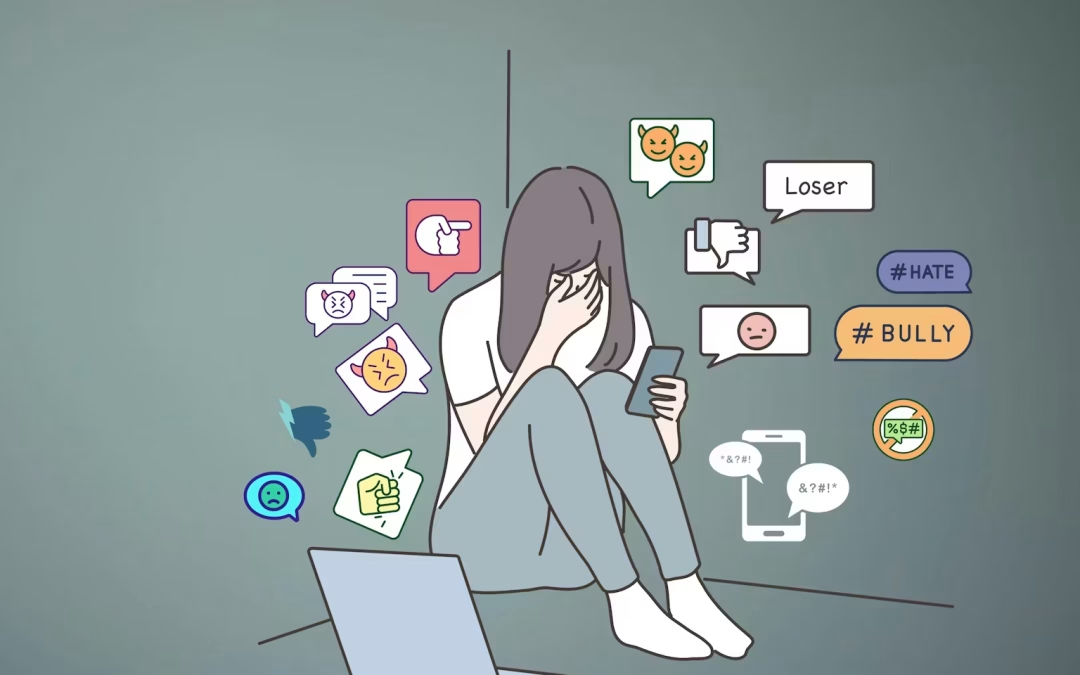
Cyberbullying remains a documented concern. Research using machine learning to analyze social media interactions highlights that online aggression continues to impact adolescents’ and young adults’ mental well-being, including increasing stress and social withdrawal. (arXiv, 2025)
These studies collectively suggest that social media doesn’t simply reflect our offline behavior — it amplifies it. The digital environment can embolden actions by removing the immediate social consequences present in real-world interactions. Whether this leads to prosocial or antisocial behavior often depends on context, platform design, and individual personality traits.
Importantly, not all online behavior is harmful. For many users, social media provides safe spaces to express ideas, connect with communities, and access support that might be unavailable offline. But the convenience and perceived safety of screens also create a culture where empathy and restraint can be reduced.
To encourage healthier online interactions, experts recommend promoting digital accountability, mindful engagement, and empathy-driven platform design. Teaching users to recognize the psychological mechanisms that make certain behaviors easier online than in person can help bridge the gap between digital and real-world social norms.
Social media should extend human connection, not allow us to abandon the standards of behavior we uphold in the real world.