
(Photo: MSN)
United States — May 23, 2026
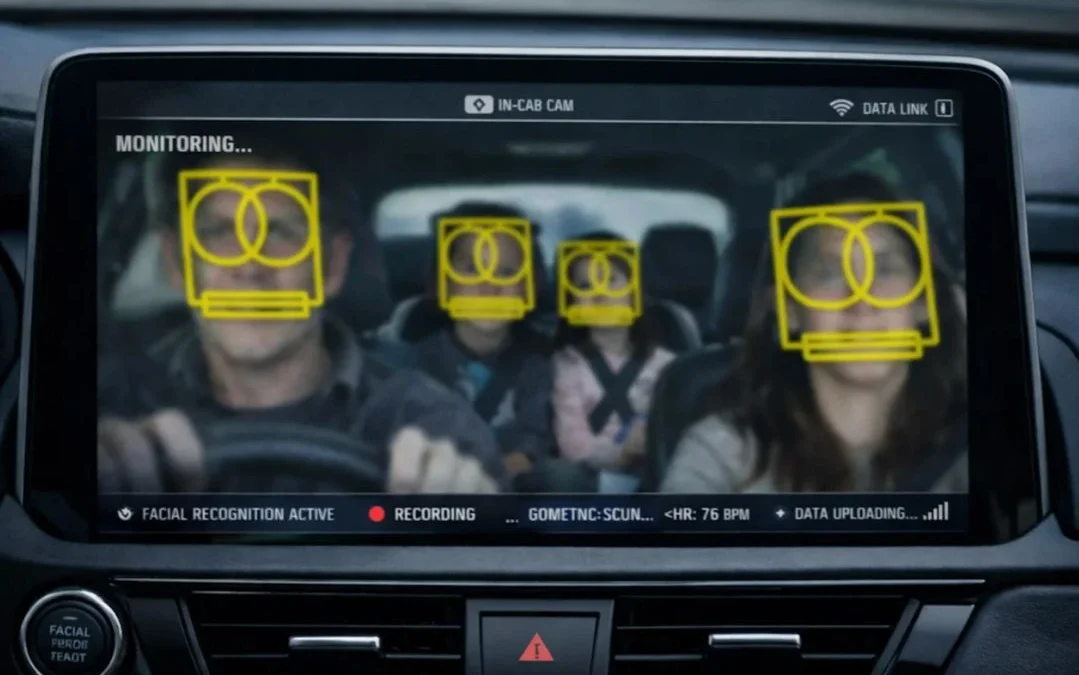
The federal push toward requiring AI-powered driver monitoring systems in all new vehicles by 2027 is being sold as a road safety breakthrough. But stripped of the marketing language, it raises a more uncomfortable question: how much constant observation inside a private car is too much?
The National Highway Traffic Safety Administration’s plan, rooted in earlier federal legislation aimed at reducing impaired driving deaths, would require new vehicles to be equipped with systems capable of detecting signs of distraction or impairment using in-cabin cameras and sensors. In theory, the goal is straightforward—stop dangerous drivers before they cause harm. In practice, it opens the door to something far more intrusive: continuous behavioral tracking inside one of the last semi-private spaces people still have.
Unlike traditional safety features such as seatbelts or airbags, these systems do not just respond to crashes or physical conditions. They interpret behavior in real time—eye movement, head position, attentiveness, responsiveness—and make judgments about a driver’s state. That means every trip becomes a monitored interaction between the driver and the vehicle’s internal systems.
Supporters argue this is simply the next step in automotive safety, comparable to anti-lock brakes or automatic emergency braking. But that comparison breaks down when you consider what is actually being measured. This is not mechanical performance. It is human behavior under continuous observation.
Privacy concerns are not hypothetical here. Even if most systems are designed to process data locally, the broader trajectory of automotive technology has consistently moved toward increased connectivity, data retention, and integration with external services. Once the infrastructure for constant monitoring exists in every vehicle sold, the question is no longer whether the data could be used beyond safety purposes—but who will control it, and under what limits.
There is also the issue of error. Driver monitoring systems are not perfect. False positives—mistakenly flagging a driver as impaired or distracted—are not just technical glitches. In a regulatory context, they could escalate into real consequences: restricted vehicle operation, forced alerts, or intervention systems overriding driver control.
That raises a deeper concern: what happens when a machine is given authority to interpret human behavior in real time and act on it?
None of this is to dismiss the public safety problem the policy is trying to address. Impaired driving is a serious and persistent issue, and technology may play a role in reducing fatalities. But safety policy that expands surveillance into everyday private life deserves scrutiny proportional to its reach.
A car is not a public square. It is not a workplace camera system. It is one of the few remaining spaces where people expect a baseline level of autonomy and privacy. Turning that space into a monitored behavioral environment represents a significant shift—not just in transportation policy, but in how much observation society is willing to accept in exchange for safety.
The debate over this rule is not really about technology. It is about boundaries. And once those boundaries move, they rarely move back.