
(Photo: Recovery)
New York, NY — January 28, 2025
Let’s begin with a simple truth: masturbation and healthy sexual curiosity are normal human behaviors that are not themselves harmful. There’s nothing intrinsically wrong with adults exploring their sexuality or seeking pleasure in private. The danger arises, however, when the ecosystem of online pornography — instant, algorithm‑driven, and increasingly extreme — turns normal curiosity into compulsive behavior and exposes vulnerable people (especially children) to harm.
Easy Access Has Created a New Landscape
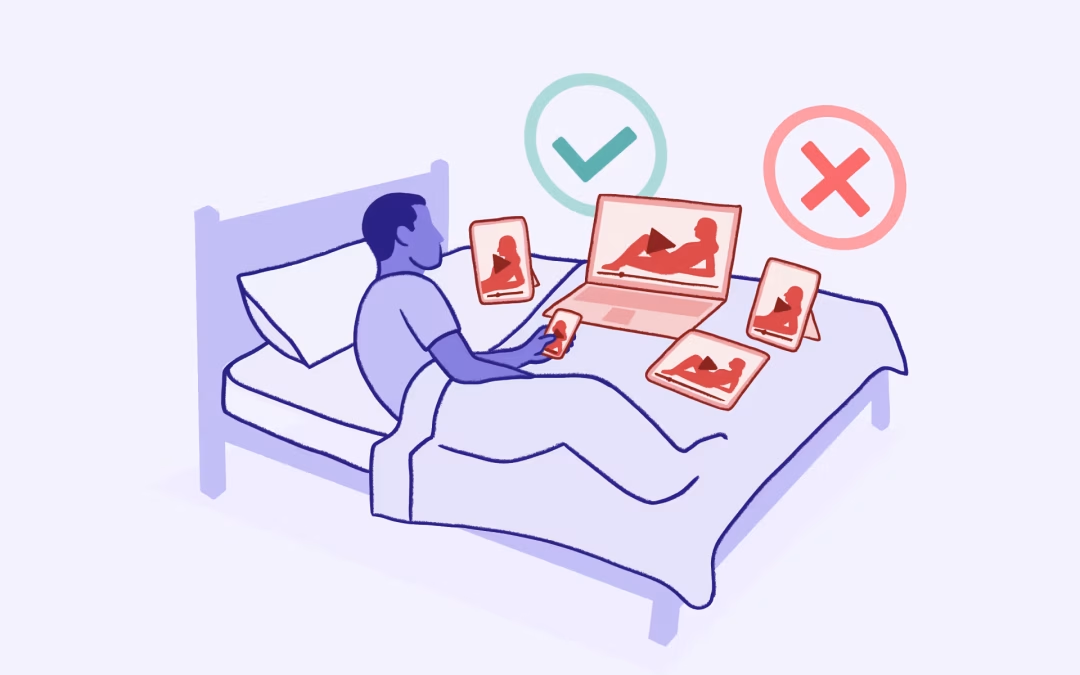
Pornographic content is now accessible with a swipe or a click on almost any device. This has dramatically lowered the barrier to exposure — including for children who are far too young to contextualize what they’re seeing. According to data, many adolescents first encounter pornography at a very early age, with the average age of first exposure often reported as around 11 years old or younger. Studies also show that a significant percentage of youth acknowledge that online pornography is easy to access and pervasive.
While psychologists debate the exact definition of “porn addiction,” surveys suggest that a notable minority of adults report problems with compulsive use — for example, one representative study found that about 11% of males and 3% of females in the U.S. self‑reported feeling addicted to pornography.
There is also emerging clinical evidence that compulsive pornography use — sometimes called Problematic Pornography Use (PPU) — is linked with stress, anxiety, and negative life outcomes. A recent study from NIMHANS found that individuals with escalating pornography use reported distress, relationship impact, and difficulty stopping despite negative effects.
Age Verification Laws: A Step — But Only a Step
In 2025, a wave of U.S. state laws has sought to prevent minors from accessing sexually explicit material online by requiring sites to verify a visitor’s age through government‑issued IDs or other methods. In June 2025 the U.S. Supreme Court upheld a Texas age‑verification law — potentially paving the way for similar statutes in many states.
The intention is understandable: protect children from material they should never see. But age‑verification mechanisms are imperfect in practice. Technology like VPNs (virtual private networks) can easily circumvent location‑based restrictions, and basic age checks (“I am 18+”) do little to stop determined minors from accessing sites.
Meanwhile, regulators and civil rights advocates worry that some approaches to verification risk privacy and free‑speech concerns, especially when platforms must store personal identification to prove age.
Beyond Addiction: Exploitation and Abuse Online
This conversation isn’t just about addiction. There’s a dark side to the adult internet that goes far beyond “normal” sexual exploration.
Major platforms have faced legal accountability for failing to curb harmful content. In 2025, the U.S. Federal Trade Commission and the state of Utah reached a settlement with Pornhub’s parent company (Aylo) over allegations it deceived users about its efforts to block child sexual abuse material (CSAM) and non‑consensual content — requiring the company to implement stronger prevention measures and pay a penalty.
Critics point to older litigation as well, including class‑action suits and claims involving companies such as MindGeek (Pornhub’s former parent) over videos that featured coerced or non‑consensual material, and in some documented cases, content involving minors.
This isn’t hypothetical: campaigns like Traffickinghub were founded to expose and oppose the distribution of material linked to exploitation and trafficking — raising awareness of how digital platforms can incidentally amplify abuse.
So What’s the Cause of the Problem?
The issue isn’t sexual desire or masturbation, which are part of healthy adult experience. The issue is that we have built a system that:
-
Normalizes instant access to explicit content for all ages,
-
Uses engagement algorithms that push users toward more extreme or novel material,
-
Makes it easy for minors to bypass protections,
-
And has historically hosted material that exploited victims of coercion or trafficking.
This combination of technological convenience, commercial incentive, and weak safeguards can warp the natural trajectory of healthy sexual development, especially for young people or those with underlying vulnerabilities.
We Need Nuanced Solutions
If we truly want to protect people — especially children — without resorting to censorship or fear‑mongering, we need to:
-
Improve sex education — teaching young people about consent, relationships, and digital literacy, not just abstinence.
-
Expand awareness of harmful patterns — including how some compulsive use resembles addiction and when it benefits from professional support.
-
Update technology safeguards — age verification must be thoughtful: not simply bureaucratic boxes to check, but robust, privacy‑preserving systems that actually target minors’ risks.
-
Enforce real content responsibility — platforms must be accountable for preventing CSAM and non‑consensual material, not just offering click‑through disclaimers.
In 2025, the conversation about pornography needs to be honest — not moralistic, but reality‑based. There’s nothing wrong with sexual expression. There is a problem when the tech ecosystem turns that expression into a compulsive maze of addiction risks, easy access for children, and platforms that have historically failed to protect the most vulnerable.
Addressing this honestly, compassionately, and effectively is not only necessary — it’s long overdue.