
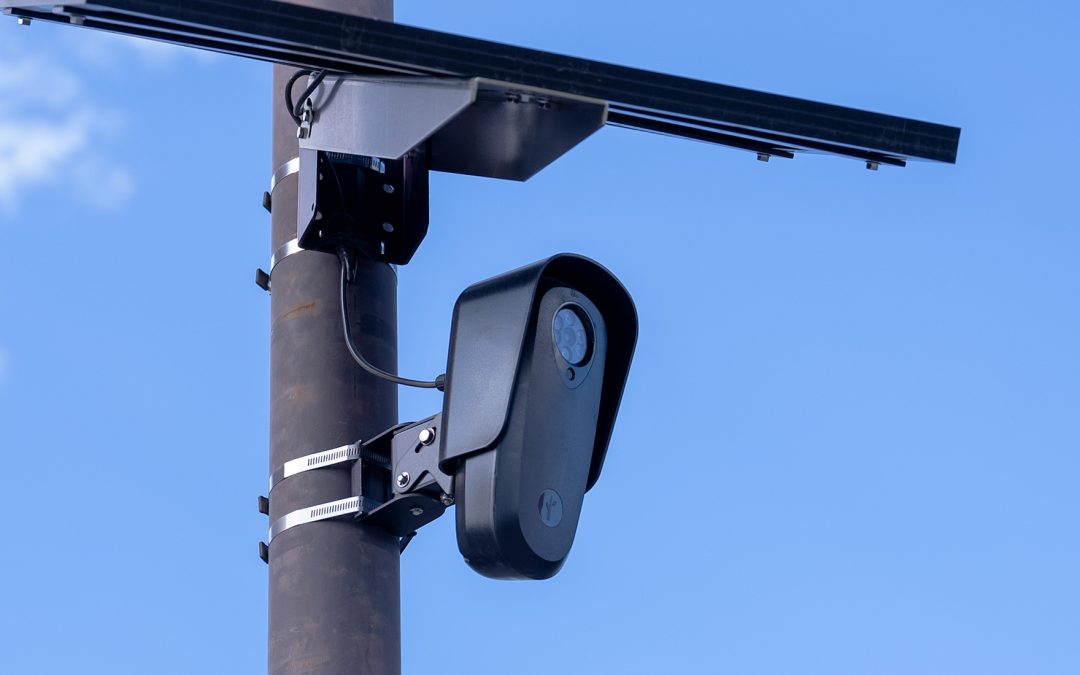
(Photo: AZPM News)
United States — May 29, 2026
Automated license plate readers (ALPRs) — widely deployed by law enforcement agencies through vendors like Flock Safety — are rapidly becoming one of the most extensive surveillance tools in the United States. What began as a targeted law enforcement aid for stolen vehicles and AMBER Alerts has increasingly evolved into a persistent, interconnected tracking infrastructure with limited public oversight and a growing record of documented misuse.
At a basic level, the technology is simple: cameras positioned on streets, poles, or private property capture license plates, timestamps, and location data as vehicles pass. That information is stored and made searchable by law enforcement, often across jurisdictions and sometimes across state or regional networks.
Supporters argue this improves policing efficiency, helping officers locate stolen vehicles and respond to urgent alerts faster than traditional methods. But civil liberties groups and investigative reporting have repeatedly raised concerns that the scale and persistence of data collection creates a system capable of reconstructing detailed movement histories of ordinary people — regardless of whether they are suspected of wrongdoing.
The concern is not theoretical. There are documented cases of law enforcement officers misusing license plate reader systems for personal purposes, including tracking individuals outside of legitimate investigative contexts. Investigations have identified instances in which officers queried ALPR databases to monitor people they knew personally, including romantic partners or acquaintances, raising serious questions about access controls and oversight.
These cases highlight a broader structural issue: the systems are designed for broad access by law enforcement agencies, but oversight mechanisms often rely on internal audits, logs, or departmental discipline rather than real-time external accountability. When access is widespread and friction is low, misuse does not need to be widespread to be significant — it only needs to be possible and difficult to detect.
Compounding the issue is the way data is shared across jurisdictions. ALPR networks increasingly allow agencies to query data beyond their local boundaries, creating de facto regional or national datasets of vehicle movement. Civil liberties researchers warn that this interoperability can turn what was originally intended as a localized investigative tool into a distributed surveillance system spanning multiple states.
Security concerns add another layer of risk. Lawmakers have raised questions about whether large-scale ALPR systems are sufficiently protected against unauthorized access or data breaches, given the sensitivity of continuous location tracking records. If compromised, such databases could reveal extensive movement histories of millions of drivers.
Defenders of the technology often point out that courts have generally held there is no reasonable expectation of privacy for license plates displayed in public. But that argument becomes less clear when individual sightings are transformed into persistent, searchable histories. The legal distinction between “public observation” and “continuous tracking” is increasingly where the policy debate is now focused.
This is the central tension: the system is not controversial because it sees cars on public roads — it is controversial because it remembers them, stores them, and makes them searchable long after the moment of observation has passed.
As ALPR deployment expands, the regulatory framework governing it remains fragmented, varying widely by state and municipality. Some jurisdictions impose strict limits on retention and access, while others allow broader sharing and longer storage periods. The result is a patchwork system where the level of surveillance a driver experiences can change simply by crossing a city or state line.
The core question is no longer whether license plate readers are useful. They clearly are. The question is whether the legal and ethical boundaries around them are evolving fast enough to match the scale of their deployment.
And right now, the answer appears to be no.