
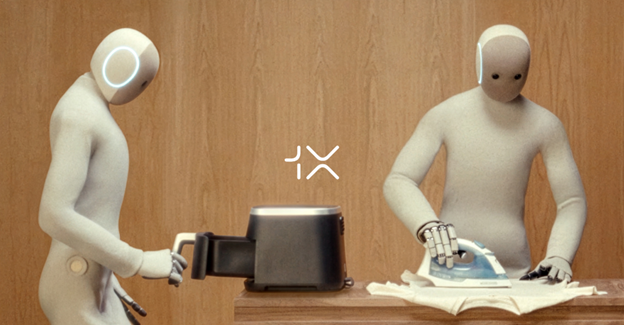
(Photo: 1X Technologies)
Palo Alto, CA — January 12, 2026
We’re being told that the age of humanoid robots — the helpers of science fiction — is finally upon us. But let’s be honest: robots like 1X NEO, Figure 03, and Tesla Optimus are not the autonomous household partners Hollywood promised. They’re remarkable feats of engineering, sure — but they’re also expensive, incomplete, and still heavily constrained by current AI, safety, and privacy limitations.
Figure 03: Designed for the Home — but Not Yet There
Figure AI’s Figure 03 is one of the most intriguing humanoid robots because it’s explicitly designed for domestic environments. It’s lighter than its predecessor, wrapped in soft textiles with foam padding for safer interactions around people and pets, and equipped with advanced vision, tactile sensors, and wireless charging — all targeted at home usability.
In demonstrations, Figure 03 can navigate living spaces, handle common objects, and even show potential for tasks like cleaning or loading a dishwasher. Its proprietary “Helix” AI integrates vision, language, and action to help it interpret commands and physical environments.
But here’s the reality check: Figure 03 is not yet a consumer product — there’s no public release date or pricing, and the company itself says it won’t be fully ready for home use at launch. That means for now, it’s a promising prototype, not a robot you can order from Best Buy to fold laundry under your roof.
1X NEO: The Only One You Can Actually Pre‑Order
In contrast, 1X Technologies’ NEO is actually on preorder now, with deliveries targeted for 2026 at a price of roughly $20,000 upfront or about $499/month. NEO is marketed as a household assistant capable of helping with chores and basic interactions — but early versions still depend heavily on human tele‑operators for complex tasks.
1X aims to change that with its 1X World Model, an AI framework intended to let NEO learn directly from its own video experiences and require less human help over time. But learning from video doesn’t equate to full human‑level autonomy. It’s a step, but not the giant leap consumers are hoping for.
Tesla Optimus: Not Really a Home Robot Yet
Then there’s Tesla’s Optimus, which has arguably gotten the most hype of all. Despite flashy demos and CEO statements, Optimus has no official retail sales date, price, or confirmed home deployment plan — and many production targets have reportedly slipped.
Optimus may be used in controlled industrial settings first and may eventually make its way into homes, but as of early 2026, it’s nowhere near being a product you can buy and rely on to manage your pantry or pet your dog.
Who These Robots Are Actually For
| Robot | Availability / Status | Intended Audience | Realistic Ability Today |
|---|---|---|---|
| Figure 03 | Announced, home‑oriented design; no consumer sale date | Future home adopters & enterprises | Prototype capabilities; safety focused |
| 1X NEO | Preorders open; 2026 deliveries targeted | Early adopters & tech enthusiasts | Assisted tasks; partial autonomy |
| Tesla Optimus | No announced consumer availability | Industrial first, consumer long‑term | Demo tech; limited real‑world use |
This snapshot shows that only NEO is actually purchasable right now, while Figure 03 promises home orientation but isn’t shipping, and Optimus is essentially a concept/industrial project.
Privacy & Safety: The Elephant in the Living Room
If you let one of these robots into your home, it will see you, hear you, map your spaces, and learn from your behavior. In some cases — especially early deployments — human tele‑operators may be involved in assisting or training the robot, meaning a real person could be virtually “inside” your house.
Even if companies promise not to sell your data, constant video and audio feeds from private living spaces raise serious privacy concerns. What if logs are subpoenaed? What if they’re hacked? What about renters, guests, or children who didn’t consent? With no binding privacy protections yet in place, these questions remain largely unanswered.
Security concerns aren’t limited to privacy either — robots that navigate physical spaces must be safe by design. Digital vulnerabilities or controller exploits could lead to physical harm or accidents if someone loses control of a powerful, autonomous machine.
The Gap Between Hype and Reality
Despite all the headlines, we are still far from humanoid robots that independently manage households like Jarvis or Rosie. Real‑world demonstrations, even for the most advanced prototypes, show robots stumbling or failing at tasks that small children manage effortlessly — cluttered environments, unstructured tasks, and unpredictable conditions remain huge hurdles.
For the robots we see in countless sci‑fi movies — machines that intuitively understand context, multitask, and behave with human‑level general intelligence — the timeline is not months, but likely decades away. These systems require breakthroughs not just in hardware, but in AI understanding, reasoning, safety, and human‑robot interaction.
Conclusion: Tempered Optimism, Not Blind Hype
Humanoid robots like Figure 03, 1X NEO, and Tesla Optimus represent exciting progress in robotics and embodied AI. They showcase engineers pushing the boundary of what machines can do. But until they actually prove themselves in real homes without constant human supervision, and address the very real privacy/security concerns of living spaces, they remain what they truly are: a long way from the robot helpers of our imagination.
The future is promising — but let’s be honest about where we really are. Let’s demand transparency, robust privacy protections, and realistic expectations from the companies marketing these systems. Only then will we build robots worth inviting into our lives.