
(Photo: Getty Images)
United States — May 24, 2026
Across the United States, renewed battles over congressional maps are once again exposing a structural problem that has been allowed to deepen for years: the use of redistricting as a political weapon rather than a democratic safeguard.
Recent and ongoing legal and legislative fights over district maps in multiple states — including high-profile disputes in places like Louisiana and Alabama — have brought the issue back into national focus. At the center of these conflicts is not just disagreement over boundaries, but a more fundamental question about whether elections are still designed to reflect voters, or increasingly designed to predetermine outcomes.
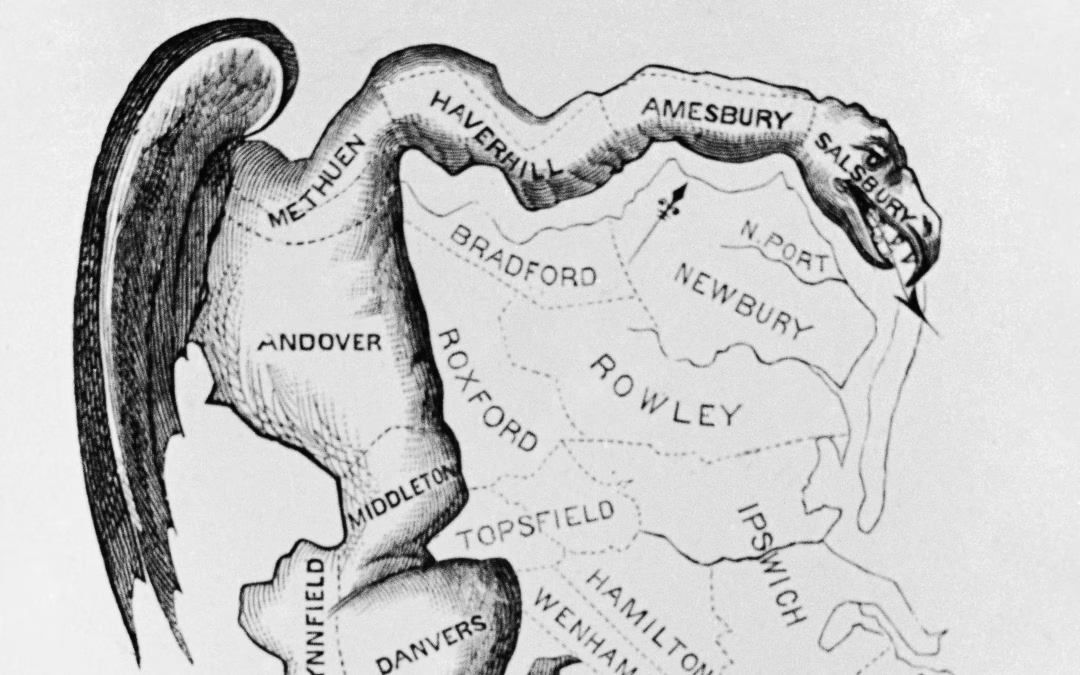
Gerrymandering has long been part of American politics, but its modern form is more precise, more data-driven, and more effective at shaping results before voters ever cast a ballot. Advanced mapping tools allow lawmakers to draw districts with extreme accuracy, separating or concentrating voting populations in ways that significantly reduce electoral competition.
The outcome is a system where many districts are no longer meaningfully contested. Instead, they are engineered environments where one party is heavily favored, and where the real contest often happens in the redistricting process itself rather than in the general election.
Supporters of aggressive redistricting argue that it is a constitutional responsibility left to states, and that political considerations are an unavoidable part of map drawing. But legality is not the same as democratic health. A system can comply with the law while still undermining the principle that citizens should have an equal and meaningful voice in choosing their representatives.
That is the core issue at stake. When district lines are drawn primarily to secure advantage rather than reflect communities, the value of individual votes is diluted. Some votes become functionally more powerful than others depending on how district boundaries are configured. That imbalance does not just affect outcomes — it affects trust in the system itself.
Recent court disputes and legislative actions underscore how unstable the current system has become. Maps are increasingly being challenged, revised, or blocked in court, reflecting the tension between partisan objectives and legal standards intended to protect fair representation. But even when courts intervene, the cycle often resets with the next round of redistricting, leaving little structural reform in place.
The deeper concern is not simply which party benefits in any given state or cycle. It is that the normalization of strategic map manipulation weakens the foundational expectation that elections are meant to reflect the will of the electorate. Over time, that expectation erodes confidence in institutions and reduces the perceived legitimacy of electoral outcomes.
Citizens do not need perfectly engineered fairness in every aspect of governance. But they do need equal, equitable, and effective representation — where votes carry comparable weight and outcomes are not effectively locked in before campaigns even begin.
When gerrymandering becomes the norm rather than the exception, it shifts the system away from voter-driven representation and toward outcome-driven design. That shift is not just a technical issue of district boundaries. It is a democratic one.
The long-term risk is not just political imbalance, but institutional fatigue — a growing sense among voters that participation carries diminishing influence over actual governance. Once that belief takes hold, it becomes significantly harder to restore trust, even if the maps themselves change.
American democracy depends on the principle that representation flows from the people. Anything that weakens that link — regardless of which side benefits — weakens the system as a whole.