
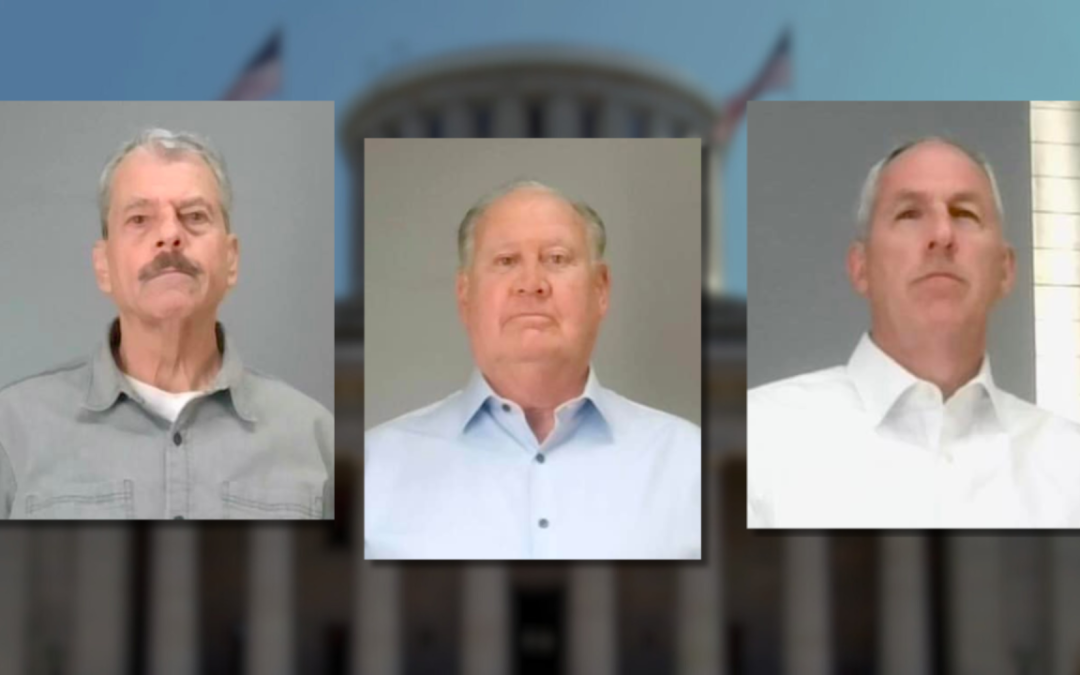
(Photo: From left to right: Former PUCO Chair Sam Randazzo, former FirstEnergy CEO Chuck Jones, former FirstEnergy VP Michael Dowling. (Mugshots from the Summit County Sheriff’s Office. Graphic by WEWS)
Akron, OH — April 3, 2026
Ohio’s largest public corruption case suffered another setback this week after a jury failed to reach a verdict in the criminal trial of two former FirstEnergy executives, resulting in a mistrial and leaving key allegations in the House Bill 6 scandal unresolved.
The trial of former FirstEnergy CEO Chuck Jones and former executive Michael Dowling ended on April 1 after jurors in Summit County Common Pleas Court in Akron were unable to reach a unanimous decision following weeks of testimony and deliberation. The case was formally declared a mistrial by the presiding judge.
Prosecutors had alleged that the executives participated in a bribery scheme tied to the passage of House Bill 6, a 2019 Ohio law that provided billions in subsidies for nuclear power plants linked to FirstEnergy. Central to the case was an alleged $4.3 million payment connected to former Public Utilities Commission of Ohio Chair Sam Randazzo, whom prosecutors said was improperly influenced in exchange for favorable regulatory treatment.
The mistrial marks the latest unresolved chapter in a broader corruption investigation that has already resulted in major convictions and corporate penalties. Former Ohio House Speaker Larry Householder was previously convicted in federal court for orchestrating a separate but related bribery scheme involving the passage of House Bill 6 and sentenced to 20 years in prison.
FirstEnergy, meanwhile, has admitted to its role in the broader scandal through a federal deferred prosecution agreement reached in 2021 and has since paid hundreds of millions of dollars in settlements and regulatory penalties. In November 2025, Ohio regulators ordered more than $250 million in refunds and penalties tied to the company’s conduct.
The House Bill 6 case has been widely described by prosecutors and investigators as one of the most significant public corruption scandals in Ohio history, involving allegations that utility money was used to influence legislation and regulatory decisions at the highest levels of state government.
With the mistrial, prosecutors are now expected to evaluate whether to retry the case. Defense attorneys, meanwhile, have argued that the payments in question were legitimate business transactions rather than bribes, and that prosecutors failed to prove criminal intent beyond a reasonable doubt.
The case continues to draw attention across Ohio’s political and legal communities, where it has reshaped debate over utility regulation, campaign finance rules, and corporate influence in state policymaking.
Despite multiple convictions in related proceedings, the latest trial underscores how much of the HB6 investigation remains unresolved nearly six years after the legislation first became law.