
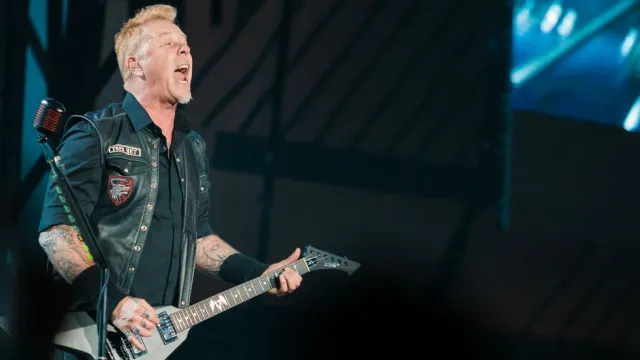
(Photo: Getty)
LAS VEGAS, Nevada — October 12, 2026 — Metallica frontman James Hetfield has drawn criticism after telling concertgoers that the band is not there to influence them with political “bullshit,” but instead wants audiences to forget about the outside world and focus on “love, energy and heavy music.” The remarks, delivered during the band’s October 10 performance at the Las Vegas Sphere, came amid a wider debate over artists speaking out about the war in Gaza, allegations of sexual violence and the suffering of civilians under governments accused of grave abuses. For critics, the controversy raises an uncomfortable question: when powerful entertainers dismiss political advocacy as an unwanted distraction, are they defending the freedom to enjoy music—or helping make indifference seem respectable?
Metallica has spent decades building its reputation on music about war, alienation, institutional failure and the darker sides of human nature. Its songs have given generations of listeners an outlet for anger at a world that often seems determined to destroy itself.
Yet when the discussion moves from the lyrics to the real-world crises that inspire political debate, the band appears eager to draw a boundary.
There is nothing inherently wrong with wanting a concert to be an escape. Music can provide relief from financial stress, personal struggles and an endless cycle of disturbing headlines. Artists should not be forced to turn every performance into a political rally, and audiences should not have to agree on every issue to share an appreciation for music.
But Hetfield’s comments went beyond a simple promise to concentrate on the music. By taking a swipe at performers who use their platforms to address political issues, he entered the very debate he appeared to want to avoid.
That distinction matters.
When civilians face bombardment, students experience or report sexual violence, and governments stand accused of devastating the lives of ordinary people, public figures are entitled to choose whether they speak. But those who choose silence should not assume that their position is automatically above criticism, particularly when they publicly disparage others for speaking out.
Metallica does not have to solve the world’s problems. The band should, however, expect its public statements about political expression to receive the same scrutiny it applies to the choices of other entertainers.
Hetfield’s Comments Were About More Than Music
During Metallica’s October 10 concert at the Las Vegas Sphere, Hetfield thanked fans for traveling to see the band and spending their time and money on the experience.
He then drew a distinction between Metallica and unnamed entertainers who, in his view, use their concerts to influence audiences with political messaging.
“Metallica’s agenda is love, energy and heavy music,” he told the crowd, according to reporting published on October 12 by music publications and the San Francisco Chronicle. <Cite refs={[“turn995944news3″,”turn995944news6”]}/>
Hetfield did not identify any performer by name. Nevertheless, his remarks emerged during a prominent dispute over the role of political advocacy at concerts, leading some commentators to interpret them as an indirect criticism of rapper Macklemore.
The timing is significant, although the band’s intended target remains unconfirmed.
In September, Macklemore was removed from the remaining dates of Ed Sheeran’s U.S. tour after making pro-Palestinian statements during a performance. The tour promoter said the decision followed discussions with stakeholders and venue owners. Macklemore subsequently announced plans for a concert tour supporting Palestinians, saying that remaining apolitical during a genocide was no longer acceptable. <Cite refs={[“turn995944news18″,”turn995944search1”]}/>
Israeli officials reject the characterization of their country’s actions in Gaza as genocide. The legal classification of the conflict requires careful examination of evidence and international law.
The disagreement between the performers reflects a larger debate about whether musicians should use their platforms to address humanitarian crises or preserve concerts as spaces devoted exclusively to entertainment.
Hetfield is entitled to prefer the latter approach for Metallica. The difficulty is that his remarks did not simply describe the band’s own policy. They also dismissed the choices of artists who have decided that their public platforms should serve a broader purpose.
A musician can reject a particular political position without suggesting that political advocacy itself is illegitimate.
The difference is between saying, “We are here to play music,” and implying that other artists are doing something objectionable when they use their stages to discuss the suffering of other people.
Metallica could have made the first statement without making the second.
The Privilege of Telling People to Forget
There is something revealing about the promise of forgetting the outside world.
For someone attending a concert, forgetting can mean two hours away from work, financial pressures, family responsibilities or the exhaustion of following breaking news. That relief is real, and there is nothing inherently wrong with seeking it.
But the ability to treat a crisis as background noise is not shared equally.
For a family displaced by bombardment, a student facing sexual violence, a civilian living under a repressive government or a parent searching for a missing child, the outside world is not an inconvenient headline that can be switched off at the entrance to an arena.
It is the reality that determines whether they can return home safely.
This does not mean that concertgoers are morally obligated to spend every waking hour confronting tragedy. Nor does it mean entertainment is worthless during periods of suffering. Art can help people survive difficult circumstances precisely because it offers moments of connection, relief and emotional release.
The objection is different: why should an artist’s desire to provide an escape become an argument against other artists who choose to confront reality?
A musician can offer a temporary refuge without suggesting that political expression is an intrusion. A band can celebrate the unifying power of music without implying that performers demanding justice are ruining the experience.
The choice is not between entertainment and humanity. It is whether entertainment must be insulated from every uncomfortable question to remain entertaining.
Hetfield is entitled to his preferred approach to performing. But when a global superstar publicly dismisses political expression, critics are entitled to question the worldview behind that dismissal.
The world does not stop being real because the lights go down.
When Silence Becomes a Public Statement
The familiar defense of celebrity neutrality is that musicians are entertainers, not elected officials. They have no special authority to dictate public policy, and their fame does not automatically make their political opinions more informed than anyone else’s.
There is truth in that argument.
A musician’s popularity does not confer expertise in international law, military strategy or human rights investigations. Celebrities can spread misinformation, oversimplify conflicts and turn complicated questions into slogans. Their audiences should be skeptical of political pronouncements simply because they come from famous people.
But none of that establishes that artists should remain silent about injustice.
A person does not need to be a diplomat to oppose the killing of civilians. An artist does not need a law degree to demand that allegations of sexual assault be investigated fairly and that victims be protected. A performer does not need to write legislation to express concern about a government using its power against ordinary people.
There is a difference between claiming authority over a complicated issue and acknowledging that the issue deserves public attention.
Silence, too, can have consequences. It can leave the public conversation to governments, corporations and organized political movements with far greater resources. It can make a humanitarian emergency easier to ignore. And when a famous artist goes out of their way to criticize those who speak, silence becomes something more active: a defense of the idea that political advocacy is inappropriate in a space the artist controls.
That does not make every silent musician complicit in the actions of a government. It does not establish that Metallica supports any particular regime, military campaign or political movement. Such conclusions would go beyond the available evidence.
But it does mean that an appeal to neutrality should not end the discussion.
If an artist insists on keeping politics out of a performance, the public can still ask why that boundary matters so much, especially when the artist is willing to make a public statement criticizing other performers’ choices.
Neutrality is not always an endorsement of the status quo. Sometimes it is simply a personal boundary. Yet it is not automatically above criticism.
A Band That Has Sung About War Should Understand Why Artists Speak
Metallica’s own musical history makes this controversy particularly interesting.
The band has never been exclusively a vehicle for political protest. Its catalogue explores addiction, alienation, mortality, personal struggles and many other subjects that do not fit neatly into a political category.
Nevertheless, some of its most enduring songs confront war, institutional power and the human consequences of violence.
“One” portrays the devastating experience of a soldier left profoundly injured by war. “Disposable Heroes” criticizes the expendability of soldiers within military systems. “For Whom the Bell Tolls” draws on the human cost of battle, while “…And Justice for All” confronts corruption and the failure of justice.
These songs do not constitute a comprehensive political platform, and their existence does not obligate Metallica to adopt a position on every contemporary conflict. Artistic expression is not a binding contract requiring musicians to comment on every issue their listeners consider important.
Still, these songs demonstrate that Metallica understands the emotional territory surrounding war, institutional violence and human suffering.
The band’s music has helped listeners process precisely the kinds of questions that political crises force societies to confront: Who pays the price for decisions made by those in power? What happens when institutions treat people as disposable? And what does justice mean when the systems responsible for delivering it fail?
It is fair to ask why a band so comfortable exploring those questions through music becomes dismissive when other performers address them in public.
The answer may be that Metallica sees a difference between art and direct political advocacy. That is a defensible personal philosophy.
But it is not the only defensible position. Nor does it justify treating other artists’ engagement with public suffering as an illegitimate attempt to influence an audience.
A song about the brutality of war and a statement condemning civilian suffering are not identical acts. Yet both can emerge from the same basic conviction: that human beings should not be reduced to collateral damage in the pursuit of power.
Artists Who Speak Out Can Pay a Price
One reason the debate over political music matters is that speaking out is not always the easy option.
Musicians who address controversial issues can face professional consequences, public backlash, canceled appearances and attempts to discredit their motives. The dispute surrounding Macklemore illustrates how quickly political expression can become a question of access to major stages.
On September 14, Reuters reported that Macklemore had been removed from the remaining U.S. dates of Sheeran’s tour after making pro-Palestinian remarks at a September 4 concert at MetLife Stadium in New Jersey. The tour promoter said venue owners had indicated that they would not host concerts featuring Macklemore. <Cite refs={[“turn995944news18″,”turn995944search2”]}/>
The episode illustrates the commercial pressures that can surround political expression. Promoters and venue operators must consider their own obligations, audiences and business relationships. Artists must decide whether the attention and potential consequences of speaking are worth accepting.
Those decisions can be complicated, and it would be simplistic to assume that every performer who stays quiet is motivated by money.
But there is an uncomfortable asymmetry when an artist with enormous commercial success uses that position to criticize people who accept the risks of speaking publicly.
The musician who condemns civilian suffering or challenges a government’s treatment of people may place professional opportunities at risk. The musician who declines to comment may preserve the ability to appeal to a wider audience without confronting those disagreements.
Neither decision, by itself, reveals everything about an artist’s character. But the choices are not necessarily equivalent in their consequences.
When a famous band describes political advocacy as an unwanted agenda, it is worth asking whether the band is defending artistic freedom for everyone or simply defending its own preference not to be challenged.
Metallica cannot reasonably expect to exercise its freedom to remain silent while treating the freedom to criticize that silence as an offense against entertainment.
Human Rights Should Not Be Reduced to Team Politics
Another weakness in the argument that concerts should be free from politics is the assumption that speaking about human suffering necessarily means endorsing a political faction.
That is not true.
Condemning the killing of civilians does not require supporting every organization fighting a war. Demanding investigations into sexual violence does not require endorsing a particular party. Calling for the protection of students does not require adopting an entire ideological platform.
Human rights should not depend on whether victims belong to the correct political camp.
Allegations of sexual violence and abuse arising in conflicts, universities and authoritarian systems deserve serious investigation. Victims should be able to report abuse without intimidation, and allegations should be assessed using credible evidence rather than political convenience. Specific claims must be documented carefully, particularly when they involve identifiable people or institutions.
The same principle applies to allegations of genocide. The term carries a specific meaning under international law, and its application to a particular conflict requires careful consideration of evidence and legal findings.
The gravity of the accusation makes precision more important, not less.
But insisting on precision should not become an excuse for indifference.
People can debate the legal classification of a military campaign while still demanding civilian protection, humanitarian access and accountability for alleged abuses. They can disagree about the appropriate political solution while recognizing the humanity of people living through the conflict.
An artist who raises these issues is not necessarily asking the audience to accept an entire political worldview. The artist may simply be asking the audience not to look away.
That is why dismissing performers’ political statements as “bullshit” is so frustrating. It collapses a broad range of possible messages—from partisan campaigning to basic appeals for human dignity—into a single dismissive category.
Metallica is free to reject partisan campaigning at its concerts. It should not assume that every appeal for human rights is equally unworthy of consideration.
What Does Metallica Owe Its Audience?
The obvious counterargument is that Metallica owes its fans music, not political declarations.
That is largely correct. Buying a concert ticket does not entitle an audience member to demand a speech on every crisis in the news. Nor should fans have to pass an ideological test to enjoy a performance.
Artists should be allowed to create spaces where people from different backgrounds can share an experience without agreeing on every political question. That is one of music’s genuine strengths.
But the relationship between a major band and its audience is not purely transactional. Artists cultivate public identities, communicate values through their work and make statements that shape how fans understand their place in the world.
Metallica’s own comments on October 10 demonstrate that the band is willing to address the subject of politics from the stage. Hetfield could have thanked the audience, introduced the next song and continued the show. Instead, he chose to make a point about entertainers who use their platforms to influence people.
That choice invites scrutiny.
If Metallica’s position is that every artist should be free to determine the relationship between music and politics, the band can make that argument without disparaging those who choose differently. If its position is that a concert should be a temporary refuge from the news, that preference can be expressed without suggesting that political speech is an unwelcome intrusion into public life.
The contradiction is not that Metallica refuses to endorse a specific cause. It is that the band used its own platform to criticize the use of other platforms for political expression.
Fans are not obligated to agree with Hetfield’s view. They can continue to love the music while questioning the message. They can also decide that a band whose work once helped them confront the world’s ugliness is now offering a vision of entertainment that feels too comfortable with looking away.
That is not censorship. It is criticism, the same kind of freedom the band itself exercises when it decides what to say onstage.
Commercial Success Does Not Require Moral Leadership—but It Invites Scrutiny
Metallica is one of the most successful heavy metal bands in history. Its stature gives its members a platform that most people will never have, but that stature does not automatically create an obligation to become political leaders.
Fame is not a public office. Musicians are not required to become experts on international affairs, and their audiences should not confuse artistic achievement with moral authority.
Nevertheless, influence brings visibility, and visibility creates choices.
Metallica has demonstrated that it can mobilize resources for causes beyond music. Through its All Within My Hands foundation, established in 2017, the band has supported workforce education, hunger relief and community services. Its programs include the Metallica Scholars Initiative, which supports community colleges, as well as partnerships with food banks and humanitarian organizations.
That record complicates any sweeping claim that the band does not care about people or refuses to contribute to society. Its charitable work deserves recognition.
But charitable giving and public advocacy are different forms of engagement. Supporting a food bank does not answer every question about how an artist should respond to war, alleged atrocities or political repression. Nor does choosing not to issue a public statement negate every other contribution an artist makes.
The criticism, then, should be narrower and more defensible than simply declaring Metallica heartless or morally bankrupt.
The problem is not that the band has failed to solve a global crisis. The problem is that Hetfield used his platform to belittle political expression at a moment when other artists were attempting to draw attention to grave humanitarian concerns.
The band could have chosen not to address politics. Instead, it chose to criticize the people who do.
That decision deserves to be judged on its own terms.
The Danger of Treating Comfort as a Moral Position
There is a reason people turn to music during war, political upheaval and personal tragedy. Music can restore a sense of community when institutions fail. It can give language to emotions that are difficult to articulate. It can help people feel less alone.
A great concert can provide that kind of refuge without requiring the audience to ignore the world permanently.
But comfort becomes a more troubling ideal when it is elevated above every competing responsibility. If the purpose of entertainment is always to help audiences forget, what happens when forgetting becomes a social expectation? What happens when the people drawing attention to a crisis are portrayed as the ones ruining the experience?
The danger is not that every concert becomes a political rally. It is that public culture begins to treat uncomfortable realities as inappropriate subjects for discussion wherever commercial entertainment is involved.
That would be an impoverished understanding of art.
Some of the most consequential cultural works have forced audiences to confront injustice rather than escape it. Others have offered moments of beauty and connection without explicitly addressing politics. Both approaches can be meaningful. Neither should be treated as the only legitimate form of artistic expression.
The freedom to entertain and the freedom to protest can coexist.
Metallica can deliver a night of heavy music. Another performer can dedicate a song to civilians killed in a war. A third can criticize a government’s conduct, organize a benefit concert or demand accountability for sexual violence. Audiences can evaluate those choices on their merits.
The existence of political art does not threaten the existence of apolitical entertainment.
What threatens a healthy cultural conversation is the assumption that public figures who speak about suffering are necessarily imposing something illegitimate on everyone else.
The world is full of people who would prefer not to hear about violence, displacement, repression or injustice while they are trying to enjoy themselves. That preference is understandable. It does not make the underlying realities any less urgent.
And it does not make the people who insist on discussing them the problem.
Metallica Can Keep the Music. The Public Can Keep Asking Questions.
Metallica is not obligated to become a political organization. Its members have every right to decide what they want their concerts to represent, and their charitable work deserves recognition rather than dismissal.
But those facts do not put the band beyond criticism.
Hetfield’s October 10 remarks were not simply an announcement that Metallica would stick to music. They were a public swipe at performers who use their visibility to address political issues. In doing so, he invited a larger question about whether the world’s biggest entertainers should treat humanitarian concerns as distractions from their commercial product.
The answer should be straightforward: artists do not all have to speak, but those who choose to speak should not be ridiculed merely for believing that the suffering of others deserves attention.
When civilians are being killed, students face allegations of sexual violence and governments stand accused of devastating the lives of ordinary people, demands for accountability should not be dismissed as an inconvenient agenda. The specific facts of each allegation must be established, and political slogans should never replace serious reporting. But neither should uncertainty about every detail become a convenient reason to reject the subject altogether.
Metallica’s members have earned their success through decades of work, and their music will continue to mean something to millions of people. That legacy does not disappear because Hetfield makes a statement that fans find disappointing.
Yet the band’s legacy does not exempt it from the same scrutiny it directs at other performers.
The question is not whether Metallica is too old to matter or whether its music has lost all value. The question is whether a band that has spent decades giving voice to anger, alienation and the consequences of violence now believes that the best response to real-world suffering is to tell audiences to forget about it.
If that is the message, the band should expect criticism.
A concert can be an escape without becoming an argument for indifference. Heavy music can bring people together without demanding that they leave their consciences at the door. And artists can disagree about politics without dismissing the act of speaking about human suffering as bullshit.
Metallica is free to play its songs, collect its ticket revenue and leave political advocacy to other musicians. The public is equally free to decide that this position, particularly when delivered as a rebuke to artists who speak out, represents a disappointing use of an extraordinary platform.
The world does not need every rock star to become an activist. It does need us to stop pretending that caring about what happens beyond the concert arena is somehow incompatible with enjoying the music inside it.
Metallica can keep the stage. It cannot reasonably demand that everyone else stop talking about the world outside.