
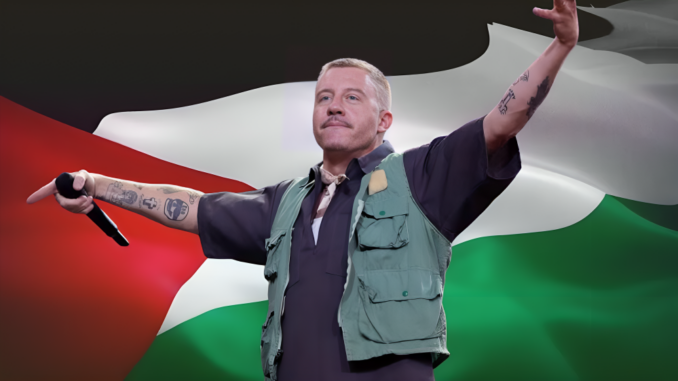
(Photo: Social Media)
DUBLIN, Ireland — October 1, 2026 — Macklemore’s newly announced “Free Palestine” tour has sold out all three of its initial European dates, with tickets disappearing shortly after going on sale. The Grammy-winning rapper announced the sellouts on September 30, just days after revealing plans for a series of concerts dedicated to Palestinian solidarity and humanitarian aid. The response marks a significant moment for an artist who has faced professional fallout over his political statements, raising a broader question for the music industry: what happens when an artist refuses to separate entertainment from the causes they believe in?
The three concerts are scheduled for Dublin on October 26, Paris on October 29 and London on October 30. Macklemore has said additional performers will be announced and that further U.S. dates are planned. Proceeds from the shows will benefit organizations supporting Palestinians, including groups providing humanitarian assistance, medical aid and community support. [1][2]
“I’m honestly blown away,” Macklemore said after announcing that all three shows had sold out. He described the concerts as an effort to bring musicians and audiences together around Palestinian liberation, humanitarian support and collective action. [1]
The rapid sellout is particularly notable because the tour emerged from a controversy that threatened to limit the rapper’s opportunities on one of the year’s major concert tours.
Earlier in September, Macklemore was removed from the remaining U.S. dates of Ed Sheeran’s Loop Tour following his outspoken pro-Palestinian comments. Rather than retreat from the issue, he announced a separate series of concerts that places the cause at the center of the event.
Now, with all three announced European shows sold out, the project offers a different picture of what can happen when an artist’s political convictions become inseparable from their public identity.
For Macklemore, the concerts are intended to raise money for Palestinians while demonstrating that audiences are willing to support artists who take controversial positions. For fans, attending is an opportunity to participate in an event that connects live music with a broader humanitarian cause.
The sellouts do not establish that every ticket buyer shares the same political views. They do, however, demonstrate that there is substantial demand for the announced shows and that the controversy has not prevented Macklemore from attracting an audience for this project.
Three Cities, One Message
Macklemore announced the “Free Palestine” concerts on September 24, less than two weeks after reports emerged that he had been removed from Sheeran’s tour.
The initial schedule includes three major European cities:
- Dublin, Ireland — October 26: 3Arena.
- Paris, France — October 29: Accor Arena.
- London, England — October 30: OVO Arena Wembley.
The shows were organized on a relatively short timeline, with additional artists expected to join the lineups. Macklemore has also indicated that U.S. performances are forthcoming. [2][3]
The choice to organize a separate tour allowed the rapper to build an event around the cause he wanted to promote rather than treating political advocacy as a secondary part of a larger commercial production.
That distinction matters. A performer can express solidarity during a conventional concert, but a dedicated benefit tour makes the humanitarian purpose part of the event’s central premise.
Macklemore’s announcement also emphasized the importance of musicians supporting one another and creating spaces for political expression.
The sellouts suggest that the concept has found an audience. Rather than waiting for an established tour to provide a platform, Macklemore created a new one—and fans responded quickly enough to fill all three announced venues.
The ultimate financial impact will depend on the event costs, the proceeds available for distribution and how much money the shows ultimately generate. Nevertheless, the announced commitment to direct proceeds toward Palestinian aid organizations gives the tour a purpose beyond ticket sales alone.
Why Macklemore Was Removed From Ed Sheeran’s Tour
The new tour follows a dispute over Macklemore’s political statements during a September 4 performance at MetLife Stadium in New Jersey.
During the show, Macklemore voiced support for Palestinians and used the phrase “Free Palestine.” He had been scheduled to appear at additional dates on Sheeran’s Loop Tour, but the tour promoter subsequently confirmed that he would no longer perform at the remaining shows. [3][4]
The decision drew attention because it raised questions about who controls the political boundaries of major concert productions.
According to reporting by Reuters, the promoter said venue owners had indicated they would not host events featuring Macklemore. Macklemore also alleged that billionaire businessman Robert Kraft had played a role in efforts to have him removed. Kraft’s representatives and the other parties involved should be distinguished from those allegations; the existence of the dispute does not, on its own, establish every claim about who influenced the decision. [3][4]
Sheeran subsequently said the decision had been made by the tour promoter rather than by him personally.
The episode illustrates the complicated relationships among artists, promoters, venue operators, sponsors and other commercial stakeholders. A performer may have a contract to appear at a concert, but the production depends on a network of organizations whose interests do not always align.
Political speech can therefore become a business issue even when the artist is not campaigning for public office or asking the audience to support a particular candidate.
For Macklemore, the removal created a clear choice: move forward without the tour or build a separate project around the message that had helped trigger the controversy.
He chose the latter.
From Professional Setback to a New Platform
Macklemore’s response is significant because it turns a dispute over access to a major stage into an opportunity to create another one.
Being removed from a major concert tour can affect an artist’s income, exposure and relationship with the wider entertainment industry. The consequences depend on the terms of the arrangement, the number of dates affected and the availability of alternative opportunities.
But the development of the “Free Palestine” tour demonstrates that losing one platform does not necessarily eliminate an artist’s ability to reach an audience.
Macklemore’s announcement gave fans a direct way to support a new project. Rather than simply issuing another statement about his removal, he organized concerts with an explicitly humanitarian objective.
He also pledged $1 million from his net earnings from Sheeran’s tour to six organizations supporting Palestinians and challenged Kraft to match the donation. Kraft subsequently announced a separate $2 million commitment toward humanitarian aid in the region. These pledges were reported amid the dispute over Macklemore’s removal. [2][3]
The distinction between a pledge and a completed donation remains important. The ultimate amounts distributed to recipients should be confirmed through subsequent reporting or documentation from the organizations involved.
Even so, the announced commitments demonstrate how a controversy involving an artist can lead to additional attention and fundraising for humanitarian causes.
The new concerts extend that approach by connecting Macklemore’s public position to a series of live events.
Rather than making the dispute the entire story, the tour gives the rapper an opportunity to build something that can continue beyond the initial controversy.
Where the Money Is Going
The humanitarian purpose of the tour is central to its significance.
According to the Associated Press, the announced beneficiaries include organizations involved in humanitarian relief, health care, community support and advocacy for Palestinians. The list includes Anera, Gaza Soup Kitchen, Taawon, HEAL Palestine, the Palestinian Youth Movement, the Middle East Children’s Alliance, Medical Aid for Palestinians, the Palestinian Children’s Relief Fund, Jewish Voice for Peace and UNRWA USA, among others. [2]
These organizations do not all perform the same role. Some provide direct assistance, including medical services and food relief, while others focus on community programs, advocacy or public education.
The range of recipients reflects an effort to support Palestinians through several different forms of assistance rather than concentrating the proceeds in a single organization.
For people following the humanitarian crisis in Gaza, the stated purpose of the tour offers a practical component to the public message. Attendees are not simply purchasing tickets to hear a performer discuss an issue; the event is being organized with the stated intention of directing proceeds toward organizations working on Palestinian-related causes.
However, the exact amount that will reach each beneficiary cannot be calculated from ticket sales alone. Venue costs, production expenses, contractual arrangements and other costs can affect the final proceeds.
A transparent accounting after the shows would help establish the financial impact of the tour and distinguish gross revenue from the amount ultimately donated.
That information will be important in evaluating the project’s success beyond the speed at which tickets sold.
The Bigger Question: Can Music Still Be a Form of Resistance?
Macklemore’s tour arrives during a wider debate about the responsibilities of musicians and other public figures when they confront political or humanitarian crises.
Some artists argue that their primary responsibility is to entertain. Others believe their visibility gives them an opportunity to draw attention to issues that might otherwise receive less public attention.
Neither position automatically determines whether a particular artist is acting responsibly. Musicians can spread inaccurate information, simplify complicated events or use political causes to enhance their own public profiles. Audiences should evaluate claims carefully regardless of who makes them.
At the same time, music has a long history of serving as a vehicle for protest, solidarity and political expression.
Concerts can bring together people who might otherwise feel isolated in their views. Benefit performances can raise money for relief efforts, while songs and public appearances can draw attention to issues beyond the entertainment industry.
The “Free Palestine” tour combines those possibilities. It is a commercial event with tickets, venues and production costs, but it is also being organized around a specific political and humanitarian commitment.
The sellouts indicate that the concept has attracted enough interest to fill the three announced shows. They do not prove that the tour has changed public opinion or that every attendee agrees with Macklemore on every aspect of the Israeli-Palestinian conflict.
What they show is that the artist’s stated commitment to Palestinian solidarity has not prevented the initial European dates from selling out.
That matters in an industry where artists sometimes face pressure to avoid subjects that could alienate audiences, commercial partners or venue operators.
What the Sellouts Do—and Do Not—Prove
The immediate sellouts are a meaningful development for Macklemore, but their significance should not be exaggerated.
Three sold-out concerts do not establish that the entire music industry supports his position. They do not demonstrate that every major artist is willing to take similar risks, nor do they settle the political and legal disputes surrounding the war in Gaza.
Ticket sales also cannot tell us how much money the concerts will raise for humanitarian organizations. That will depend on the final financial accounting and the amount ultimately distributed to recipients.
What the sellouts do demonstrate is that Macklemore has been able to organize a new set of performances around a cause he has publicly defended, attract enough demand to fill the announced venues and create another platform after losing his place on a major tour.
For supporters, that is an encouraging example of an artist responding to professional adversity by building an alternative.
For the music industry, it is a reminder that political controversy does not always translate into commercial isolation. An artist who loses one opportunity may find another audience, particularly when a project offers fans a clear purpose beyond entertainment.
The longer-term test will be whether the concerts deliver meaningful financial support to their announced beneficiaries and whether the project encourages other artists to participate in humanitarian fundraising.
A Tour Built Around Solidarity
Macklemore’s “Free Palestine” tour began as a response to a controversy over his political expression. Within days of tickets going on sale, all three announced European concerts had sold out.
The sequence does not resolve the larger debate about political speech in the music industry. Nor does it establish that every decision made by the promoters, venue operators or artists involved in the original dispute was motivated by a single cause.
But the tour offers a concrete example of how an artist can respond to a professional setback by creating a new opportunity for performance, fundraising and public engagement.
The project is still in its early stages. Its ultimate impact will depend on the concerts themselves, the performers who join the lineups, the funds raised and the organizations that receive support.
For now, the rapid sellouts suggest that Macklemore’s decision to put Palestinian solidarity at the center of a concert project has resonated with a substantial audience.
The most important measure of success will not be the speed at which tickets disappeared. It will be what the tour ultimately delivers to the people and organizations it was created to support.
If the concerts raise meaningful funds, provide a platform for artists willing to participate and sustain public attention on humanitarian needs, they could demonstrate how live music can become more than a temporary escape from the world.
It can also be a way for people to decide what they want to stand for—and to act on that decision together.