
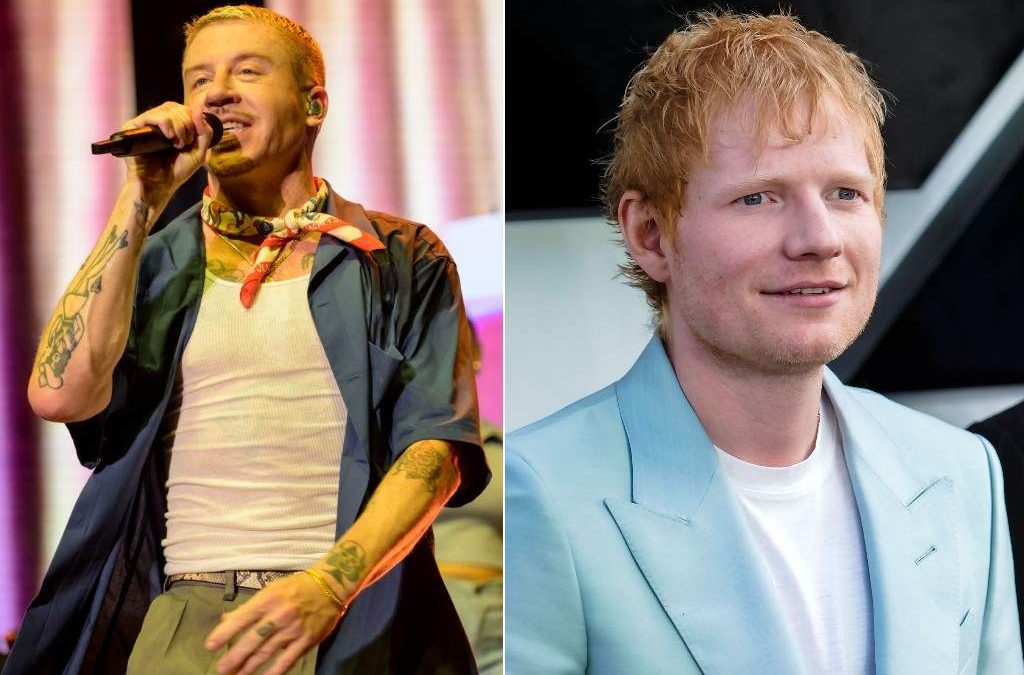
(Photo: Macklemore performs onstage during the ibis RockCorps France 2024 at Accor Arena on May 29, 2024 in Paris, France and Ed Sheeran at the European premiere of ‘F1 The Movie’ at Cineworld Leicester Square London on June 6, 2025. Kristy Sparow/Getty Images/: Imago/xJ.xEdwardsx/xFuturexImagex)
LOS ANGELES, California — September 15, 2026 — Ed Sheeran’s Loop Tour was supposed to bring music to stadiums across the United States. Instead, the tour has become the center of a growing controversy over Palestine, artistic freedom and the willingness of powerful entertainment businesses to restrict performers who speak out against the suffering of Palestinians.
The controversy erupted after rapper Macklemore was removed from the remaining U.S. tour dates following his public expressions of support for Palestinians. His removal has since prompted other performers, including Finneas, Aaron Rowe and Lukas Graham, to withdraw from upcoming appearances, turning a dispute over one artist into a broader confrontation over political expression in the music industry.
At the heart of the controversy is a question that extends far beyond one concert tour: What happens when speaking out against the suffering of Palestinians becomes a liability in the entertainment business?
As Gaza continues to endure devastating humanitarian consequences from Israel’s military campaign, artists who publicly advocate for Palestinian rights have faced intense scrutiny and criticism. Macklemore’s removal has added another dimension to that debate, raising concerns about whether commercial pressure is being used to discourage musicians from expressing solidarity with Palestinians.
Sheeran has said the decision to remove Macklemore was made by the tour’s promoter and venues rather than by him personally. But as performers withdraw and criticism grows, the singer’s tour is becoming an example of how the music industry’s commercial interests can collide with the right to speak out about human suffering.
Macklemore’s Support for Palestine Becomes a Touring Controversy
Macklemore has become one of the more prominent American musicians to use his platform to criticize Israel’s military campaign in Gaza and express support for Palestinian liberation.
His protest song, “Hind’s Hall,” takes its name from Hind Rajab, a five-year-old Palestinian girl who was killed in Gaza in January 2024. The song addresses the war, the humanitarian crisis and student protests demanding that universities reconsider their financial and institutional relationships with Israel.
The song became part of a wider wave of artistic protest as musicians, students and activists called attention to Palestinian civilian suffering and demanded greater accountability for the conduct of the war.
During performances at MetLife Stadium in New Jersey, Macklemore performed “Hind’s Hall” and expressed support for Palestinians. His remarks drew criticism from some Jewish advocacy organizations and venue stakeholders, who argued that his rhetoric crossed a line.
Robert Kraft, the owner of Gillette Stadium in Massachusetts, was among those who objected to Macklemore’s participation. Kraft has criticized the rapper over what he considers antisemitic rhetoric. Macklemore’s supporters, however, argue that advocating for Palestinian freedom and criticizing Israeli government policy should not automatically be equated with hostility toward Jewish people.
That distinction is essential to the debate.
Antisemitism is a serious form of prejudice that should be confronted wherever it appears. But support for Palestinian rights, opposition to military actions that kill civilians and demands for accountability are not inherently antisemitic. Criticism of a government and discrimination against an ethnic or religious group are not the same thing.
When those categories are treated as interchangeable, legitimate discussion of Palestinian suffering risks being pushed aside by accusations that fail to distinguish between political criticism and prejudice.
The controversy surrounding Macklemore demonstrates how difficult it has become for artists to navigate those competing pressures while speaking about one of the most devastating conflicts in the world.
Other Artists Withdraw as the Backlash Grows
Macklemore’s removal did not end the dispute. Instead, it prompted a wider response from musicians associated with Sheeran’s tour.
Finneas, Aaron Rowe and Lukas Graham announced that they would withdraw from upcoming performances, adding to the uncertainty surrounding the supporting lineup.
Their departures transformed the controversy from a disagreement involving one rapper into a challenge for the entire production. They also raised a broader question about whether musicians should be expected to remain silent when another performer is removed following political advocacy.
Artists do not surrender their right to express political opinions simply because they participate in a commercial tour. Music has long been used to challenge governments, protest wars, expose injustice and bring attention to humanitarian crises.
From antiwar songs to the civil rights movement, performers have repeatedly used their platforms to confront subjects that powerful institutions would sometimes prefer to avoid.
Palestine is no exception.
For artists who believe that Palestinians are experiencing mass civilian suffering and a grave humanitarian crisis, remaining silent can feel like a moral failure. Their decisions to withdraw from the tour can therefore be understood as expressions of solidarity with a fellow performer and with the principle that speaking about human rights should not automatically jeopardize a person’s professional opportunities.
Their departures do not establish that Sheeran personally ordered Macklemore’s removal. They do, however, demonstrate the consequences of a decision that has left musicians questioning whether participation in a major tour requires accepting restrictions on political expression.
For the organizers, replacing performers may be a logistical challenge. For the artists who have withdrawn, the issue appears to be about something more fundamental than a place on a concert poster.
Gaza’s Humanitarian Crisis Is Bigger Than a Concert Tour
The controversy cannot be fully understood without considering the circumstances that have made Palestine such an urgent subject for artists and activists.
Gaza has endured extensive destruction, mass displacement, damage to civilian infrastructure and severe restrictions affecting access to food, clean water, medical care and other essentials during Israel’s military campaign following the Hamas-led attacks of October 7, 2023.
Humanitarian organizations and international bodies have repeatedly raised concerns about civilian casualties, the destruction of essential infrastructure and the conditions facing Palestinians trapped in the territory.
The term genocide has also become central to international legal proceedings and public debate. South Africa brought a case against Israel before the International Court of Justice under the Genocide Convention, alleging that Israel’s conduct in Gaza violated its obligations under international law. Israel has rejected the allegations.
The International Court of Justice issued provisional measures in the case, ordering steps intended to protect rights asserted under the Genocide Convention while proceedings continue. Such provisional measures are not a final determination that genocide has occurred.
The legal question and the humanitarian reality are related, but they are not identical. The scale of civilian suffering, the destruction of homes and essential services, and the displacement of families are subjects of extensive international concern regardless of the final legal determination.
For many supporters of Palestinian rights, that reality is precisely why musicians should be able to speak openly.
When artists perform songs about Gaza or call for Palestinian liberation, they are participating in a wider debate about civilian protection, accountability and the international community’s responsibilities toward people experiencing war.
Those messages can be controversial. But controversy alone is not a sufficient reason to dismiss the underlying humanitarian concerns.
Does Supporting Palestine Come at a Professional Cost?
The dispute surrounding Macklemore raises uncomfortable questions about the power that stadium owners, promoters and commercial partners exercise over the cultural conversation.
Major tours depend on complex arrangements involving venues, sponsors, promoters, performers and ticketing companies. Those relationships give businesses considerable influence over the conditions under which artists perform.
A venue can argue that it has legitimate reasons to object to a performer’s statements. Artists and audiences, however, can reasonably question whether such decisions are being used to discourage political positions that powerful stakeholders oppose.
The concern is particularly serious when the subject is a humanitarian crisis involving civilian lives.
If musicians believe that expressing solidarity with Palestinians could cost them touring opportunities, they may become less willing to speak publicly about the issue. That chilling effect could extend beyond one rapper or one tour, influencing how performers approach political subjects in the future.
There is a difference between holding an artist accountable for genuinely discriminatory statements and penalizing someone simply for advocating Palestinian rights. The distinction should be examined carefully rather than assumed away.
The public deserves transparency about why a performer is removed, which parties made the decision and what standards were applied.
Without that clarity, decisions affecting artists can become a source of suspicion and mistrust, particularly when they involve one of the world’s most politically contentious humanitarian crises.
Ed Sheeran’s Role in the Controversy
Sheeran has said that the decision to remove Macklemore was made by the tour’s promoter and venues rather than by him personally.
That explanation matters. A headlining performer does not necessarily control every contractual arrangement or venue policy governing a large-scale tour.
Nevertheless, Sheeran is the public face of the Loop Tour, and the controversy now surrounds a production carrying his name.
The central question is not whether Sheeran should be held personally responsible for every decision made by the businesses involved. It is whether major artists and entertainment companies are willing to defend space for political expression when doing so becomes commercially uncomfortable.
Sheeran has built a career around music that reaches audiences across national, cultural and political boundaries. That broad appeal gives him a platform that could help audiences engage with difficult issues, even when they disagree about the underlying politics.
He does not have to share every position held by Macklemore to recognize that artists should be able to raise concerns about civilian suffering and human rights.
Nor does supporting the right to speak about Palestine require endorsing every statement made by every pro-Palestinian activist.
The principle is straightforward: political advocacy should be evaluated on its actual content, and legitimate criticism of governments should not automatically be treated as hatred toward a people or religion.
As the controversy grows, Sheeran faces questions about how much influence he has over the tour’s decisions and whether there is room within the production for artists to express views that powerful commercial interests find objectionable.
The Cost of Silencing Political Expression
The music industry has never existed entirely outside politics. Artists have protested wars, criticized governments, challenged racial discrimination and campaigned for human rights throughout modern music history.
Those interventions have sometimes been celebrated decades later, even when they were controversial at the time.
The current debate over Palestine presents a similar question: Will performers be free to address a humanitarian crisis as they understand it, or will commercial pressures increasingly determine which political messages can be heard on major stages?
The removal of Macklemore and the subsequent withdrawals from Sheeran’s tour have brought that question into sharp focus.
Venues and promoters have legitimate interests in managing their events, and allegations of antisemitism should be assessed seriously. But those concerns should not become a blanket justification for treating advocacy for Palestinian freedom as inherently unacceptable.
Palestinians are entitled to have their suffering discussed. Calls for civilian protection, humanitarian assistance and accountability deserve consideration on their merits. Artists should not have to abandon every controversial subject simply because it risks upsetting a powerful business partner.
The debate is not about giving musicians immunity from criticism. It is about ensuring that criticism and commercial pressure do not become tools for shutting down legitimate discussion of human rights.
A Tour Caught Between Music and Politics
For Sheeran and the tour’s organizers, the immediate challenge is managing the remaining performances while dealing with the consequences of Macklemore’s removal.
Replacement performers may help maintain the schedule, but they cannot undo the controversy. The departures have already turned the supporting lineup into a subject of public debate and placed questions about political expression at the center of the tour’s identity.
It is too early to conclude that the Loop Tour has failed financially. The withdrawals and criticism do not, by themselves, establish that ticket sales or revenue have collapsed.
But commercial performance is not the only measure of a tour’s significance.
The controversy has exposed a difficult conflict between the business of live entertainment and the ability of artists to speak about events they consider morally urgent. It has also demonstrated how quickly a decision involving one performer can create consequences for an entire production.
At its center is a question much larger than Ed Sheeran, Macklemore or the music industry: What does artistic freedom mean if performers are free to speak only when their views do not inconvenience the people controlling the stage?
Macklemore used his platform to call attention to Palestinian suffering. His removal has prompted other performers to reconsider their participation, while Sheeran has been left to manage the consequences of a decision he says he did not make.
The tour may continue, and its commercial fate will ultimately depend on evidence rather than speculation. But the controversy has already become a reminder that music does not exist in a vacuum.
When artists speak about war, human rights and the suffering of civilians, their words can carry consequences far beyond the concert hall.
For Palestinians enduring the devastation in Gaza, the stakes are infinitely greater than a dispute over a touring lineup. The question is whether the world’s cultural platforms will remain open to those who demand that their suffering be acknowledged—or whether commercial pressure will make speaking out increasingly costly.
The music can continue. The debate over who is allowed to use the stage, and what they are allowed to say about Palestine, is far from over.