
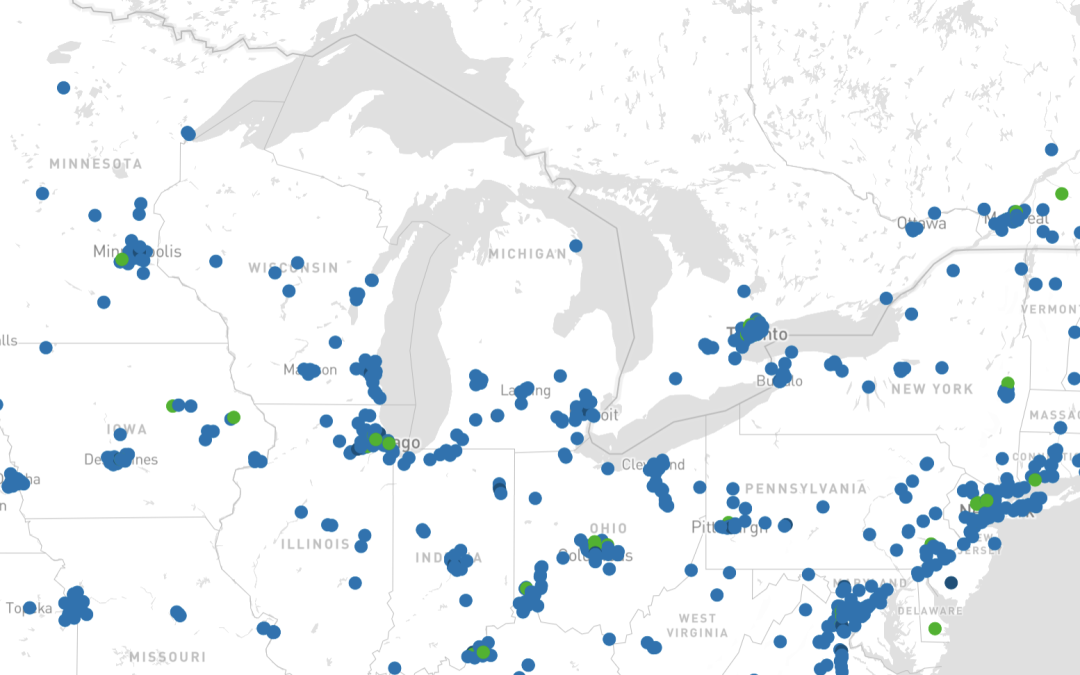
(Photo: DataCenterMap)
WASHINGTON, D.C. — October 13, 2026 — Federal energy regulators have approved a new system for tracking data centers across one of the nation’s largest electricity networks while rejecting key parts of a proposal that could have required certain facilities to provide additional power resources or face temporary interruptions during emergencies. The decision highlights a growing conflict between the rapid expansion of artificial intelligence infrastructure, the reliability of the electric grid and concerns about who ultimately pays for the electricity that keeps the technology industry running.
The Federal Energy Regulatory Commission, known as FERC, approved PJM Interconnection’s plan to develop a database tracking large data centers across its regional grid. However, regulators rejected major elements of PJM’s proposal to temporarily curtail electricity service to data centers during periods of severe supply shortages.
PJM operates the electricity transmission system and wholesale power market serving approximately 67 million people across 13 states and Washington, D.C. Its territory includes Ohio, Pennsylvania, Illinois, Indiana, Michigan, New Jersey, Maryland, Delaware, Virginia, West Virginia, Kentucky and Tennessee, as well as the District of Columbia.
The decision comes as electricity demand from data centers grows rapidly and grid operators warn that new power supplies may not keep pace with demand. Rising capacity costs have already placed pressure on electricity markets, raising concerns about the potential consequences for households, small businesses and industrial customers.
For the Great Lakes region, the issue is increasingly important. Ohio and Pennsylvania are major parts of PJM’s electricity market, while other Great Lakes states are confronting similar questions about how to power new data centers without compromising reliability or making electricity less affordable.
Federal Regulators Approve Tracking of Data Centers
The central element of the recent ruling is permission for PJM to establish a database containing more detailed information about data centers connected to its electricity network.
The system is intended to help the grid operator better understand where large facilities are located, how much electricity they expect to consume and when their demand is likely to increase.
The database is expected to collect information such as planned service dates, electricity requirements, power sources, backup generation and the schedules by which facilities increase their demand as operations expand.
Those details are important because a data center can begin operations with one level of electricity consumption and increase its demand significantly as additional servers and computing equipment are installed.
Without accurate information about those changes, grid operators can have difficulty forecasting future demand and determining how much generation and transmission infrastructure will be needed.
The database could improve the information available for long-term planning and help PJM identify potential shortages before they become emergencies.
However, tracking data centers does not itself create new electricity supplies. The database is a planning tool, and its effectiveness will depend on the accuracy of the information collected and how the grid operator uses it.
Why PJM Wanted New Rules for Data Centers
PJM has been struggling to plan for a surge in electricity demand, particularly from data centers supporting artificial intelligence and cloud computing.
These facilities can consume enormous quantities of electricity because they operate large numbers of servers continuously. They also require cooling systems and supporting infrastructure that add to their overall energy use.
PJM has projected that data center demand across its territory could rise to approximately 29 gigawatts by 2030, roughly three times the level cited in recent forecasts.
That potential growth presents a challenge for an electricity system that must maintain sufficient generation to meet demand even during periods of extreme weather, equipment failures or unexpected increases in consumption.
Building new power plants and transmission infrastructure can take years. If electricity demand grows faster than the supply system can expand, grid operators may face tighter operating margins and greater difficulty maintaining reliability.
PJM proposed new rules intended to address those concerns by requiring certain new data centers to help secure additional electricity resources or accept restrictions during emergencies.
The proposal was designed to address the possibility that large new facilities could increase demand without bringing enough additional generation online to meet their needs.
But the proposal also raised questions about whether PJM had the authority to impose those requirements and whether data centers should be treated differently from other large electricity consumers.
What Federal Regulators Rejected
FERC rejected key portions of PJM’s proposed framework, including provisions that would have allowed the grid operator to curtail electricity service to certain data centers during periods of severe power shortages.
Regulators raised concerns about PJM’s authority to establish the proposed requirements and about the justification for prioritizing data centers for interruptions ahead of other large electricity users.
The commission did not prohibit PJM from developing revised proposals. Instead, the grid operator may submit a new plan that addresses the concerns identified by regulators.
That leaves an important policy question unresolved: How should electricity systems manage new data center demand when available generation and transmission capacity may be insufficient to serve every customer during an emergency?
One option is to require new facilities to arrange additional power supplies. Another is to establish special electricity tariffs that make large customers responsible for more of the infrastructure costs they create. Utilities and regulators can also consider demand-response arrangements, under which participating customers reduce consumption under specified conditions.
Each approach involves trade-offs involving reliability, costs, fairness and the ability to attract new investment.
The recent ruling leaves PJM and state policymakers with additional work to do before a comprehensive framework can be implemented.
Could Data Centers Make Electricity More Expensive?
One of the most significant concerns surrounding data center growth is the potential effect on electricity prices.
When large new customers increase demand, utilities and grid operators may need to secure additional generation, expand transmission capacity or procure more resources to ensure the system can meet peak demand.
Those investments can affect wholesale electricity prices and capacity-market costs.
PJM’s capacity market compensates resources for being available to supply electricity when needed. The costs associated with securing adequate future capacity can ultimately influence the expenses faced by utilities and, depending on state regulation and rate structures, their customers.
PJM’s market has experienced a substantial increase in capacity costs in recent years. Federal regulators’ decision does not, by itself, establish how much household electricity bills will change in the future.
Nor does it prove that data centers are solely responsible for higher bills. Fuel prices, power plant retirements, transmission constraints, weather and other factors also influence electricity markets.
However, the rapid growth of large computing facilities has become a major concern for grid planners because it can add substantial demand over a relatively short period.
If the cost of meeting that demand is spread broadly across a utility’s customers, households and smaller businesses could bear some of the expense associated with infrastructure serving large commercial users.
That possibility has prompted calls for special rates and contractual arrangements requiring data center operators to pay a greater share of the costs associated with their electricity consumption.
The key question is how regulators can ensure that large new customers contribute appropriately to the infrastructure they require without creating unnecessary barriers to economic development.
Why Ohio and Pennsylvania Are Especially Important
Ohio and Pennsylvania are central to the debate because both are within PJM’s territory and have attracted substantial interest from data center developers.
Ohio’s existing industrial base, access to electricity infrastructure and availability of potential development sites have made it an important market for large computing facilities.
Pennsylvania is also a major electricity-producing state, with nuclear power, natural gas and other resources contributing to its energy supply.
As data center development expands, both states must consider how to provide additional electricity while protecting existing customers from unnecessary costs and maintaining grid reliability.
The implications extend beyond the locations where data centers are built. PJM operates a regional system, so changes in electricity demand, generation availability and market prices can affect customers across state boundaries.
A facility in one state may influence regional investment needs and wholesale market conditions that extend well beyond the immediate community.
That is why the federal ruling matters to Great Lakes residents even if they do not live near a major data center.
The outcome could affect future utility planning, the allocation of infrastructure costs and the rules governing how large new electricity consumers connect to the grid.
Michigan, Wisconsin and the Wider Great Lakes Energy Challenge
The recent FERC decision concerns PJM, but the underlying issue is broader than one regional grid.
Across the Great Lakes, utilities and state governments are evaluating how to supply electricity to growing industrial and commercial customers while maintaining reliable service for existing households and businesses.
Wisconsin, for example, recently became the focus of an agreement between Oracle and We Energies intended to save customers approximately $300 million in fuel costs associated with the Point Beach nuclear power plant.
Under that proposal, Oracle would purchase a portion of the electricity We Energies is obligated to buy from Point Beach, helping shift some of the associated expenses toward the technology company. The agreement remains subject to regulatory review.
That arrangement illustrates one possible approach to the cost-allocation debate: a large technology company assumes a more direct financial responsibility for electricity associated with its operations.
Other states may consider different combinations of special electricity rates, new generation agreements, transmission investments and rules governing large energy users.
Michigan also faces questions about how to supply growing electricity demand while balancing costs, reliability and environmental goals.
Although Michigan’s electricity system is not governed by PJM in the same way as Ohio’s and Pennsylvania’s, the state’s experience demonstrates that data center growth is becoming a wider regional planning issue.
The challenge for policymakers is to make sure that electricity infrastructure expands at a pace that matches demand while ensuring that the financial consequences are distributed fairly.
Can Data Centers Be Required to Bring Their Own Power?
One of the central ideas in PJM’s proposal was that certain new data centers should help secure enough additional electricity resources to cover their demand.
The approach is often described as requiring facilities to bring their own power, although the practical arrangements can vary.
A company might contract for electricity from an existing generator, finance new generating capacity, develop on-site power resources or enter into another arrangement that helps provide sufficient supply.
Such agreements can help coordinate new demand with new generation, potentially reducing the risk that existing customers will be left paying for infrastructure built primarily to serve a large new facility.
However, simply signing a power purchase agreement does not necessarily mean that a data center has created additional electricity generation. The effect depends on whether the agreement brings new resources into service, reallocates existing power or changes how available generation is used.
There are also practical questions about whether new generation can be completed quickly enough, how transmission constraints are addressed and how reliability obligations are enforced.
FERC’s rejection of key parts of PJM’s proposal means the specific framework cannot proceed as originally submitted. PJM may revise its approach, while states can examine their own policies governing large electricity users.
The debate is therefore continuing rather than ending with the federal ruling.
What Happens During a Power Emergency?
Electricity systems must maintain a balance between supply and demand. If demand threatens to exceed available supply, grid operators have several tools to preserve reliability.
They may call on additional generating resources, seek voluntary reductions in consumption, activate demand-response programs or take other emergency measures.
In extreme circumstances, operators may need to reduce electricity service to some customers to protect the wider system.
PJM’s proposal sought to establish circumstances under which certain data centers could temporarily lose grid power during severe shortages.
The idea raised concerns because data centers support services that can be important to businesses, financial systems, communications and other digital infrastructure.
It also raised questions about fairness. If a data center is treated differently from a factory or another large electricity consumer, regulators must determine whether that distinction is justified and consistent with applicable law.
FERC’s ruling rejected the proposed curtailment framework as submitted but left open the possibility of a revised plan.
The decision does not mean that the grid is guaranteed to remain free of emergencies, nor does it establish that data centers will never face restrictions. It means that PJM must address the commission’s concerns before proceeding with the rejected elements of its proposal.
The Environmental Implications of Expanding Electricity Demand
Data center development also presents environmental questions for the Great Lakes region.
The electricity used by computing facilities must be generated somewhere, and the environmental consequences depend on the resources supplying that power.
Additional demand can lead to investment in renewable energy, nuclear generation, natural gas or other resources, depending on market conditions, policy decisions and project economics.
If additional electricity is supplied by fossil-fuel generation, emissions may increase. If new demand is met by low-carbon generation, the direct emissions associated with electricity production can be lower.
Data centers can also require substantial amounts of water for certain cooling systems, although water use varies considerably by facility design, climate and technology.
For Great Lakes communities, these issues matter because freshwater resources, air quality and energy infrastructure are closely connected.
The recent FERC decision was primarily about grid rules and reliability, not an environmental approval for individual data center projects. Nevertheless, the broader growth in electricity demand makes energy sourcing, water use and infrastructure planning increasingly important subjects for public scrutiny.
Communities considering new data center developments may need information about expected electricity consumption, water requirements, backup generation and the infrastructure investments required to support operations.
What Consumers Should Watch Next
The next stage of the dispute will involve PJM’s response to FERC and the continuing efforts of state regulators and policymakers to address the cost and reliability implications of large new electricity users.
Consumers should watch for revised proposals, new utility rate cases, changes to capacity-market rules and agreements between data center operators and electricity suppliers.
It will also be important to distinguish between proposals and implemented policies. The federal ruling approved a tracking database but rejected key provisions of PJM’s curtailment plan. It did not impose a universal requirement that every data center provide its own electricity supply.
For households, the eventual effects will depend on how utilities recover costs, what new generation and transmission projects are built and how regulators allocate expenses among customer groups.
For businesses and local governments, the issue also involves the economic benefits of data center development, including construction work, tax revenue and potential long-term employment.
The goal is not simply to prevent new facilities from connecting to the grid. It is to develop rules that allow electricity infrastructure to keep pace with demand without unfairly burdening existing customers or undermining reliability.
A Regional Debate Over Who Pays for the AI Boom
Federal regulators’ decision to approve a data center tracking system while rejecting key parts of PJM’s proposed curtailment plan leaves major questions unresolved about how the electricity industry will accommodate rapid growth in artificial intelligence and cloud computing.
The database could help improve forecasting and planning. But it cannot substitute for new generation, transmission upgrades, effective rate design or clear rules governing large energy users.
For Ohio and Pennsylvania, the decision has immediate relevance because both states are part of PJM’s electricity market. For the wider Great Lakes region, it offers an early indication of the policy challenges that may accompany further data center expansion.
The debate involves competing priorities: attracting investment, maintaining reliable power, managing environmental impacts and protecting consumers from excessive costs.
Data centers may bring significant economic opportunities, but their electricity needs cannot be separated from the infrastructure and resources required to serve them.
The question facing regulators and state governments is whether the costs and responsibilities of that expansion can be allocated in a way that protects existing customers while allowing the region’s economy to grow.
The federal ruling has not settled that debate. Instead, it has sent key elements of PJM’s proposal back for further work, leaving utilities, technology companies and policymakers to determine what a workable system should look like.
For Great Lakes residents, the outcome could influence the price of electricity, the reliability of the grid and the region’s ability to attract new industries without placing an unfair burden on the people who already depend on its power system.