
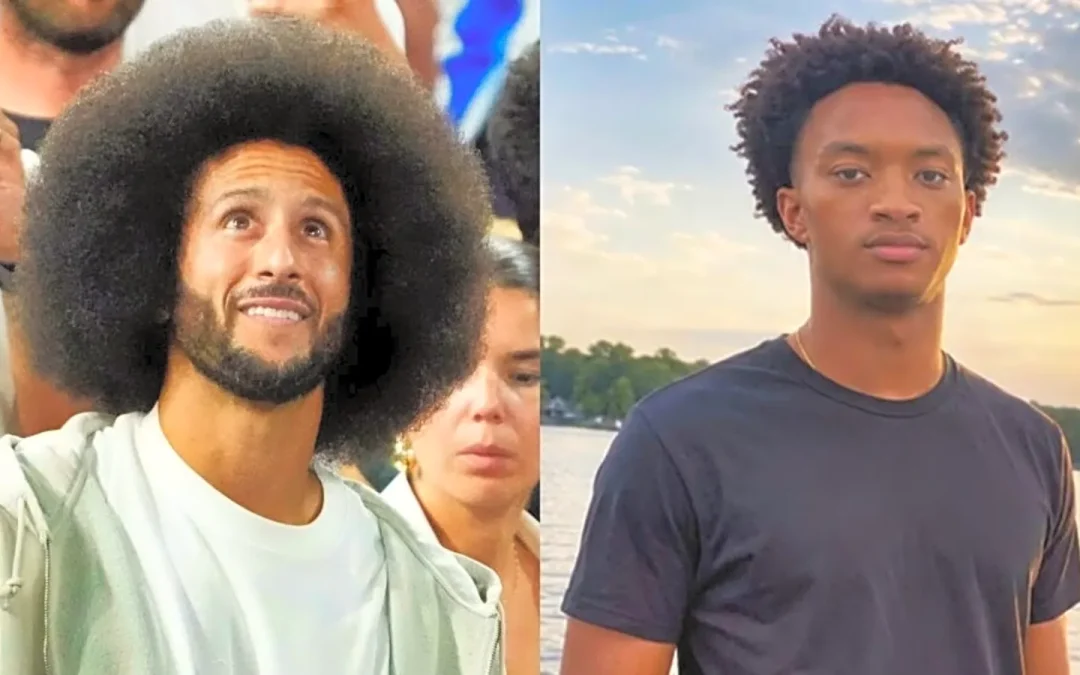
(Photo: Imagn Images and X)
CHICAGO, Illinois — July 22, 2026 — Former NFL quarterback Colin Kaepernick has paid for an independent autopsy of Nolan Xavier Wells, an 18-year-old Black student whose body was found off Mississippi’s Gulf Coast after a Fourth of July boat trip with friends. The examination, announced Wednesday by civil rights attorney Ben Crump at the NAACP National Convention in Chicago, found that Wells’s cause and manner of death remained undetermined pending further investigation. Kaepernick’s financial support has helped the family pursue additional answers as questions persist about the circumstances surrounding the teenager’s disappearance and death.
Wells disappeared on July 4 after traveling by boat to Horn Island, a barrier island off the Mississippi coast, with a group of friends. His body was recovered from the water on July 6.
The circumstances surrounding his death have drawn national attention, prompting calls from his family, civil rights advocates and public figures for a transparent investigation.
Kaepernick, the former San Francisco 49ers quarterback known for kneeling during the national anthem to protest racial injustice and police brutality, funded the independent examination conducted by Dr. Roger Mitchell Jr., a former chief medical examiner for Washington, D.C.
The findings do not establish that Wells was murdered or that another person caused his death. They also do not conclusively establish drowning as the cause. Instead, the independent pathologist reported that the available evidence was insufficient to determine how Wells died.
For Wells’s family, the examination represents an additional effort to obtain answers about a death that has left them grieving and questioning the information available to them.
The case has also renewed broader discussions about transparency in death investigations, the treatment of Black families seeking accountability and the role public figures can play in helping families pursue independent forensic examinations.
Colin Kaepernick Steps In to Help the Wells Family
Kaepernick’s contribution provided financial support for an independent autopsy after Wells’s family sought further examination of his death.
According to reporting by The Associated Press and The Washington Post, the examination was conducted by Dr. Roger Mitchell Jr., who previously served as Washington, D.C.’s chief medical examiner. Mitchell reviewed Wells’s body after a state autopsy had already been performed in Mississippi.
The independent examination took place on July 10, and its preliminary findings were announced on July 22.
Kaepernick has previously supported efforts to obtain independent autopsies through his Know Your Rights Camp initiative. The organization has worked on issues involving civil rights, education, community empowerment and the treatment of people who die in the custody of law enforcement or other authorities.
His involvement in Wells’s case places that work in a different but related context: helping a grieving family seek an additional medical examination when questions remain about the circumstances of a death.
An independent autopsy does not automatically contradict an official investigation. It provides another forensic assessment that can identify findings requiring further examination, clarify uncertainties or reach conclusions consistent with those of government medical examiners.
In Wells’s case, the independent pathologist could not determine the cause and manner of death.
That uncertainty is significant, but it must be understood accurately. An undetermined finding is not proof of foul play. It means the available evidence did not permit a definitive conclusion.
Kaepernick’s financial contribution helped make the examination possible, allowing the family to seek additional information through a forensic specialist independent of the local investigation.
What Happened to Nolan Wells?
Wells was an 18-year-old Black student and athlete from Mississippi whose death followed a Fourth of July outing with friends.
He traveled to Horn Island, a barrier island in the Gulf of Mexico, with a group of friends aboard a boat. He did not return to the mainland with the group as expected.
His body was discovered in the water near the island on July 6, two days after he was last known to have been seen.
The circumstances surrounding his disappearance prompted questions from his family and concern among community members. The fact that Wells was a young Black man who had been with white friends during the outing also drew attention from civil rights advocates.
However, the racial identities of those involved do not establish that a racially motivated crime occurred. Any such conclusion would require supporting evidence.
Wells’s family has sought a clearer account of his final hours, including information that could help establish how he died and whether the circumstances involved anything beyond an accident.
Civil rights attorney Ben Crump is representing the family and has called for additional scrutiny of the evidence.
The family’s concerns have emerged against the backdrop of longstanding public debates about how authorities investigate deaths involving Black Americans and how effectively families are informed about the findings.
Those broader concerns are relevant to understanding why the case has attracted attention. They do not, by themselves, establish misconduct in this particular investigation.
The central question remains what the available forensic evidence and investigative records can establish about Wells’s death.
Independent Autopsy Finds Cause and Manner of Death Undetermined
At a news conference during the NAACP National Convention in Chicago on July 22, Crump announced the preliminary findings of the independent autopsy.
Mitchell reported that the cause and manner of Wells’s death remained undetermined pending further investigation.
The examination identified a red discoloration in tissue at the back of Wells’s head. Mitchell characterized the finding as inconclusive and said it warranted further examination.
The report did not identify fractures or deep tissue injuries during the independent examination. However, the pathologist also described significant limitations that prevented him from reaching a definitive conclusion.
Wells’s body had undergone decomposition by the time of the independent examination, making certain findings more difficult to interpret.
Additionally, parts of the throat had been removed during the earlier state autopsy. The absence of that tissue limited the independent pathologist’s ability to evaluate some possible injuries.
The report also did not include a toxicology examination.
These limitations are important because forensic conclusions depend on the quality and completeness of the evidence available to medical examiners. When a body has decomposed or relevant tissue is unavailable, it can become more difficult to establish the precise sequence of events leading to death.
The independent findings did not prove that Wells had been assaulted. Nor did they eliminate every possibility that non-accidental factors contributed to his death.
Instead, the pathologist left the cause and manner undetermined while further information remained necessary.
The Mississippi medical examiner had conducted an initial autopsy on July 7. At the time the independent findings were announced, the state’s complete autopsy results had not been publicly released.
The independent examination therefore added information to an investigation that was still developing, rather than delivering a final explanation for what happened.
Why the Family Wanted a Second Examination
When a death occurs under uncertain circumstances, families may seek an independent autopsy to obtain another professional assessment of the available evidence.
Such examinations can help identify injuries, evaluate existing findings and determine whether additional testing or investigative steps may be warranted.
They can also have limitations. An independent pathologist may receive a body only after an initial examination, and some evidence may no longer be available in its original condition.
Those challenges were relevant in Wells’s case.
Mitchell examined Wells after the Mississippi medical examiner had already conducted an autopsy. The subsequent decomposition of the body and the absence of certain tissue complicated the independent examination.
The resulting report could not provide the definitive answer the family wanted.
Nevertheless, it documented findings that the family and its legal representatives believed warranted further scrutiny, including the discoloration at the back of Wells’s head and the limitations created by the missing tissue.
Crump presented the findings as part of the family’s ongoing effort to establish what happened.
An independent examination can contribute to that process, but its conclusions must be evaluated alongside the official autopsy, investigative records, witness accounts, laboratory results and any other relevant evidence.
Neither the family’s concerns nor the existence of unanswered questions should be treated as proof that a crime occurred. At the same time, an inconclusive examination does not mean that every question has been resolved.
The next steps depend on whether additional evidence can clarify the circumstances of Wells’s death.
Kaepernick’s Record of Civil Rights Advocacy
Kaepernick’s involvement has particular significance because of his longstanding role in public debates over race, policing and civil rights.
The former NFL quarterback became a prominent figure in 2016 when he began kneeling during the national anthem before football games to protest racial injustice and police brutality.
The demonstrations sparked a nationwide debate about patriotism, protest and the responsibilities of professional athletes. Kaepernick subsequently became a central figure in discussions about athletes using their public platforms to challenge institutions and draw attention to social issues.
After leaving the NFL, he continued his activism through Know Your Rights Camp, an organization focused on educating and empowering young people and supporting communities affected by systemic inequalities.
The organization’s initiatives have included legal education, community programming and assistance with independent autopsies in certain cases involving deaths in custody.
His financial support for the Wells family’s independent examination is consistent with that broader pattern of involvement in civil rights issues.
It also demonstrates how public figures can contribute to a family’s search for answers without personally directing a criminal investigation or determining its outcome.
Paying for an independent autopsy does not establish a particular explanation for a death. It helps make a forensic examination possible, providing another source of evidence that investigators and legal representatives can assess.
In Wells’s case, the examination produced an undetermined result, leaving important questions unresolved.
Kaepernick’s contribution therefore represents assistance with the process of seeking answers, rather than proof of any particular theory about what happened.
Civil Rights Leaders Call for Transparency
Wells’s death has attracted attention from civil rights leaders who have urged authorities to provide clear information and ensure that the circumstances are thoroughly examined.
Crump, who has represented families in several high-profile cases involving deaths and alleged civil rights violations, has emphasized the need to establish what happened to Wells.
NAACP President Derrick Johnson also appeared alongside the family during the news conference in Chicago.
The involvement of civil rights advocates reflects concerns that extend beyond one forensic examination. Families dealing with unexpected deaths often depend on investigators and medical examiners to explain complex findings, preserve evidence and communicate clearly about the progress of an investigation.
When information is limited, uncertainty can deepen a family’s distress and create space for rumors and speculation.
That is particularly consequential in cases that attract national attention, where online discussions can quickly transform unanswered questions into unsupported accusations.
A transparent investigative process can help distinguish between documented facts, unresolved issues and claims that lack evidence.
In Wells’s case, the independent autopsy provided additional information but did not resolve the central question of how he died.
The family’s request for further answers should be understood in that context. It is possible to support a thorough investigation without presuming that a particular person or group committed a crime.
Likewise, authorities should be able to explain the basis for their conclusions and clarify what evidence remains outstanding, subject to legitimate investigative and privacy constraints.
The goal is not to replace evidence with public pressure. It is to ensure that the evidence is examined carefully and that the family receives a credible explanation of what investigators can establish.
A Case With Unanswered Questions
The independent autopsy leaves several issues requiring clarification.
The first is the precise cause and manner of Wells’s death. The examination could not determine either, and the state medical examiner’s complete findings had not yet been publicly released when the independent results were announced.
The second concerns the significance of the discoloration identified at the back of Wells’s head. The independent pathologist described the finding as inconclusive, meaning it could not establish the cause or circumstances of the discoloration on its own.
The third involves the limitations created by the condition of the body and the absence of certain tissue during the independent examination. Additional records or testing might clarify some issues, although it is not possible to know in advance whether they will produce definitive answers.
Investigators may also need to evaluate witness accounts and other evidence relating to Wells’s movements and final hours.
At this stage, however, the distinction between an unanswered question and a demonstrated fact remains essential.
An inconclusive autopsy does not prove homicide. The existence of conflicting accounts, if established, would require examination rather than an automatic conclusion that someone was responsible for the death.
Similarly, a preliminary assumption of drowning should not be treated as a definitive forensic finding when the available examination has not established a cause of death.
The family is entitled to seek answers, and the public has a legitimate interest in understanding a case that has attracted substantial attention. But the credibility of that effort depends on careful treatment of the evidence and a willingness to acknowledge what remains unknown.
Kaepernick’s Contribution Helps the Family Continue Its Search for Answers
For Wells’s parents, the loss of an 18-year-old son has been compounded by uncertainty about the circumstances of his death.
The independent autopsy funded by Kaepernick has provided another forensic assessment, but it has not delivered the definitive explanation the family hoped to obtain.
The findings instead leave the cause and manner of death undetermined while highlighting limitations and questions that may require additional investigation.
Kaepernick’s role is significant because he helped the family pursue that independent examination. His support has enabled another pathologist to assess the available evidence and document findings that can be considered alongside the official investigation.
That contribution should not be confused with proof of wrongdoing, nor should it be dismissed simply because the examination was inconclusive.
In cases involving uncertain deaths, obtaining reliable information can require time, independent expertise and careful review of evidence from multiple sources.
The examination is one part of that process.
As the investigation continues, the most important questions remain whether additional evidence can establish how Wells died, whether the official findings can clarify the uncertainties identified by the independent pathologist, and whether the family can receive a complete and credible account of the circumstances surrounding his death.
For now, the independent autopsy has not established a definitive cause of death.
Kaepernick’s financial support has helped Wells’s family take another step toward finding answers. Whether that step ultimately leads to a clearer explanation will depend on the evidence that investigators and medical professionals can establish in the weeks and months ahead.