
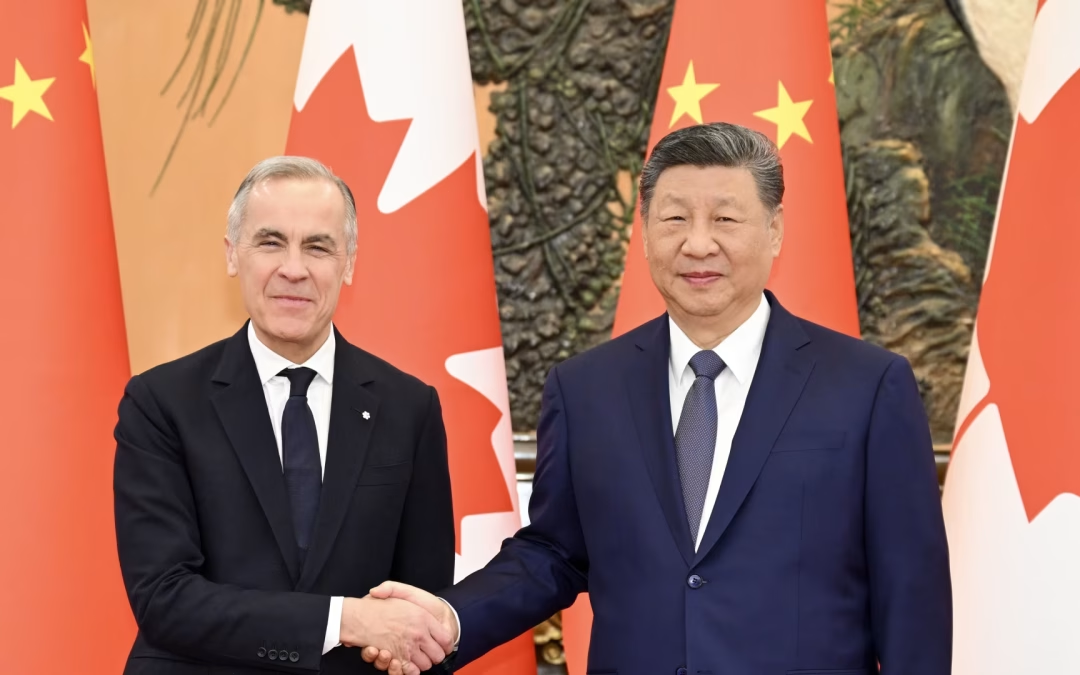
(Photo: Reuters)
Ottawa, ON — January 16, 2026
Canada and China have announced a major trade agreement aimed at easing years of economic tension and restoring market access for Canadian products in China. The deal, finalized during Canadian Prime Minister Mark Carney’s visit to Beijing, covers electric vehicles, agricultural exports, and other strategic sectors.
Under the agreement:
-
Chinese-built electric vehicles (EVs) will be allowed into Canada at a 6.1 % tariff, down from the previous 100 %. The quota allows 49,000 vehicles per year, with plans to increase to 70,000 annually over five years.
-
Canadian agricultural exports to China, including canola seed, canola meal, peas, lobster, and crab, will see significant tariff reductions or eliminations, restoring access lost during retaliatory tariffs in 2024 and 2025.
-
China agreed to reduce tariffs on canola seed to 15 % by March 1, 2026, with related products following similar reductions. The move is expected to unlock nearly $3 billion in new export opportunities for Canadian farmers.
The agreement also includes provisions for cooperation in energy, clean technology, and renewable resources, as well as expanded bilateral investment opportunities.
This deal follows a period of trade tension between the two countries. In 2024, Canada imposed high tariffs on Chinese EVs, and China retaliated with tariffs on Canadian agricultural exports, hitting key sectors like canola and seafood.
Prime Minister Carney called the agreement a “strategic reset” in Canada’s economic relationship with China. “This deal provides certainty for Canadian farmers, supports clean technology growth, and strengthens our trade diversification,” Carney said in a statement.
Canadian domestic reactions are mixed. Agricultural groups praised the restored market access, while some manufacturing advocates expressed concern about the impact of lower EV tariffs on domestic auto production. U.S. officials also voiced caution, noting potential effects on North American trade cohesion.
The agreement does not establish a full free trade agreement but functions as a sector-specific pact to address key economic challenges and opportunities. Economists say it positions Canada to increase exports to China by up to 50 % by 2030 in agriculture, energy, and technology.
With tensions between Western nations and China persisting, the deal represents a careful balancing act between economic opportunity and geopolitical strategy.