
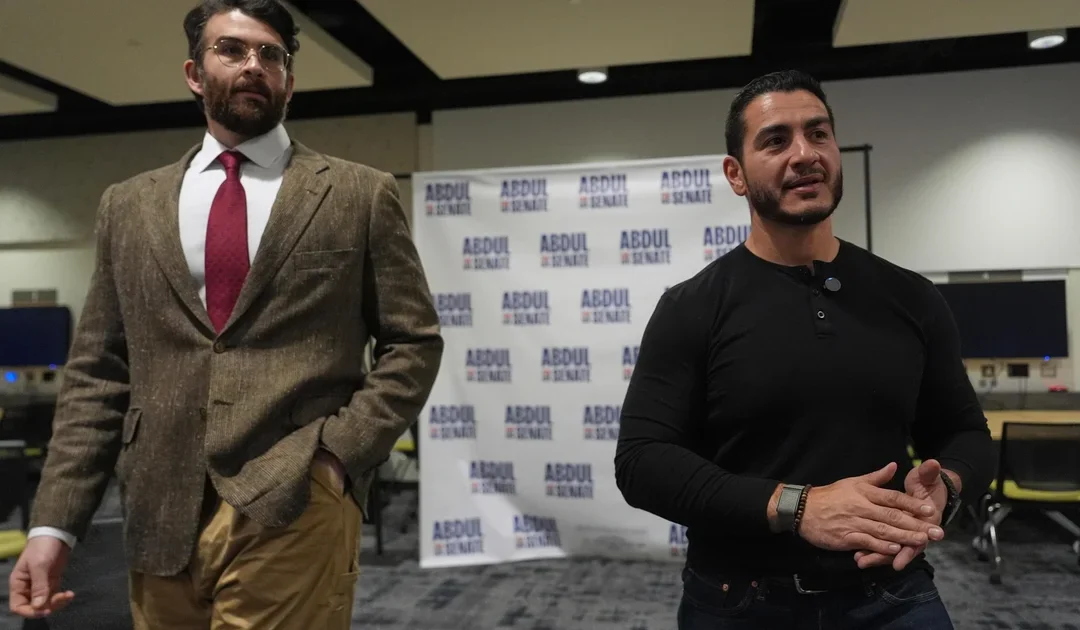
(Photo: Hasan Piker, left, listens as Abdul El-Sayed, a progressive candidate in the Democratic primary for U.S. Senate in Michigan, speaks in a green room before a campaign rally, Tuesday, April 7, 2026, at the University of Michigan in Ann Arbor, Mich.)
DETROIT, MICHIGAN — September 13, 2026 — Abdul El-Sayed, the Democratic nominee for Michigan’s U.S. Senate seat, is facing renewed questions about his relationship with political streamer Hasan Piker, as the candidate navigates growing scrutiny over the people associated with his campaign and the rhetoric they bring into the political conversation.
During an appearance on CBS’s Face the Nation on Sunday, host Weijia Jiang pressed El-Sayed on his relationship with Piker and asked why the candidate had condemned antisemitism without directly criticizing specific remarks made by the streamer.
El-Sayed responded by expressing frustration with the repeated focus on Piker, telling Jiang that it was the third time she had asked him about a California-based Twitch streamer. He argued that he had spent the week attending events in Michigan where voters were focused on other concerns.
The exchange highlights a recurring challenge for political candidates who build coalitions with influential online personalities: how to benefit from their reach while establishing clear boundaries around their own political positions.
A Campaign Relationship Under Scrutiny
Piker has become a prominent voice among younger progressive audiences, using his livestreams and online platforms to discuss politics and mobilize supporters. His involvement in El-Sayed’s campaign has attracted attention because of past remarks that critics have described as inflammatory, including comments about Israel, Zionism and American foreign policy.
El-Sayed’s association with Piker became a larger political issue after the streamer appeared alongside him during the campaign. Piker subsequently said that El-Sayed had asked him to campaign on his behalf, a claim that drew further attention to the candidate’s decision to involve him.
The controversy has put El-Sayed in the position of having to explain both the relationship and the extent to which he agrees with Piker’s statements.
For a candidate attempting to assemble a broad coalition, the issue is not merely whether a particular supporter is popular with one segment of the electorate. It is also whether the candidate can clearly communicate which views he shares, which he rejects and why he has chosen to work with a particular person.
What the CBS Exchange Revealed
Jiang’s questions focused on concerns among Jewish voters about El-Sayed’s relationship with Piker and the distinction between condemning antisemitism in general and addressing specific rhetoric directly.
El-Sayed objected to the repeated attention given to Piker, arguing that the focus was disconnected from the issues he was hearing from voters at campaign events.
His response raises two questions that are related but not identical.
First, do journalists have a legitimate reason to ask candidates about controversial figures who campaign alongside them? When a candidate publicly associates with a political commentator, voters may reasonably want to understand the relationship and whether the candidate endorses the commentator’s positions.
Second, how often should a candidate be expected to answer the same question before the interview becomes repetitive and stops producing useful information?
Both questions matter. Repeated questioning can sometimes obscure a candidate’s policy agenda, but frustration with the questioning does not itself resolve the substantive issue being raised.
The most informative answer would establish precisely where El-Sayed agrees and disagrees with Piker, rather than relying entirely on either association or distance.
Association Is Not the Same as Agreement
A political campaign is rarely made up of people who agree on every issue. Candidates receive support from voters, volunteers, donors and public figures whose views may differ from their own.
The existence of a relationship therefore does not establish that a candidate endorses everything an associate says.
At the same time, a candidate’s decision to seek someone’s help can reasonably invite questions about judgment, political priorities and the message conveyed by the partnership.
In this case, the question is particularly relevant because Piker has a substantial online audience and has publicly participated in El-Sayed’s political efforts. That makes the relationship more than a private friendship; it is part of the campaign’s public-facing coalition.
El-Sayed can distinguish his own positions from Piker’s. But the clarity of that distinction depends on what he says about the specific statements under scrutiny.
A general condemnation of antisemitism, for example, addresses an important principle. Whether it adequately answers a question about a particular person’s remarks is a separate matter.
The Political Costs of Coalition-Building
The dispute also illustrates the tensions facing progressive candidates who seek support from online political communities.
Digital personalities can bring attention, enthusiasm and access to audiences that traditional campaigns may struggle to reach. Those relationships can also introduce controversies that candidates must address, particularly when a supporter’s statements conflict with the values the campaign says it represents.
For El-Sayed, dismissing the issue as a distraction risks leaving some voters without a clear explanation of his position. Conversely, allowing every interview to revolve around Piker could prevent discussion of healthcare, economic policy and other matters central to the campaign.
The challenge is not necessarily to sever every controversial association. It is to explain the relationship honestly and establish meaningful boundaries.
That requires more than saying that a campaign speaks for itself. It requires the candidate to articulate what he believes and take responsibility for the public partnerships he chooses to pursue.
Accountability Without Guilt by Association
Ultimately, El-Sayed should be judged on his own statements, decisions and policy positions. He should not automatically be held responsible for every comment made by someone who supports him.
But the public is entitled to ask what a candidate’s alliances mean, particularly when those alliances are actively promoted as part of a campaign.
The CBS exchange did not resolve the disagreement over Piker’s rhetoric or the extent to which El-Sayed should address it. Instead, it brought the underlying tension into sharper focus: the candidate believes the attention is excessive, while journalists and some voters see the relationship as relevant to his political judgment.
The question is not whether El-Sayed must answer indefinitely for another person’s words. It is whether he can explain his own choices clearly enough that voters can evaluate them independently.
A campaign’s coalition can reveal its reach and its priorities. The responsibility for defining the candidate’s own positions, however, ultimately remains with the candidate.
As the Michigan Senate race continues, that distinction will remain central to understanding both the controversy surrounding Piker and the questions facing El-Sayed’s campaign.