
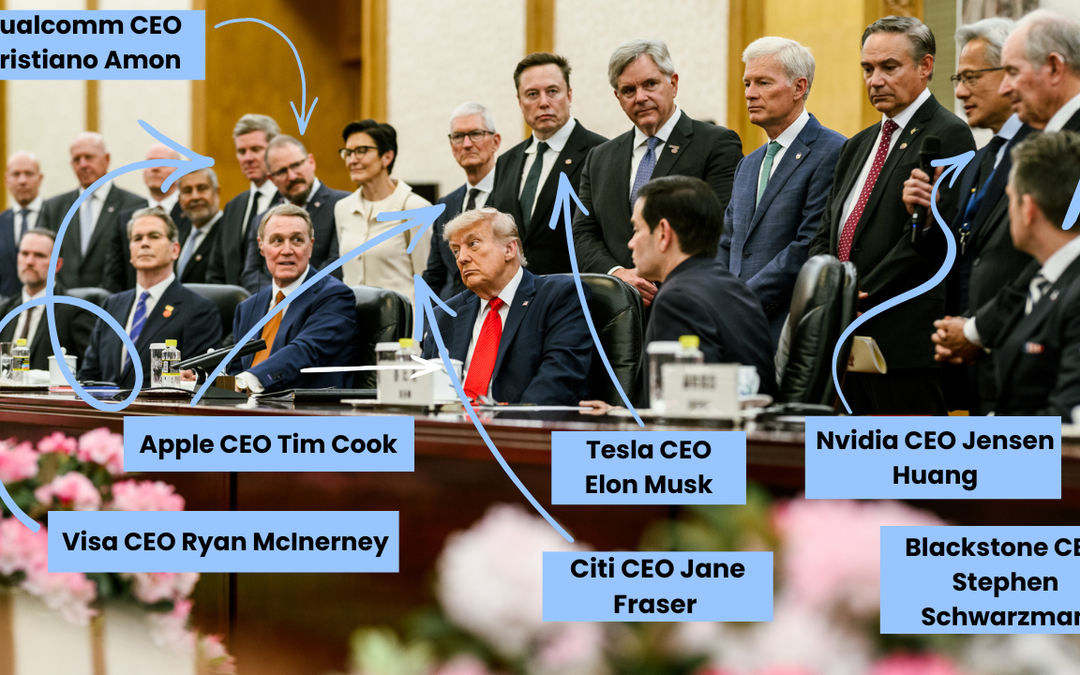
(Photo: FOX)
Beijing, China — May 15, 2026
Donald Trump’s state visit to China this week was presented as a high-level diplomatic mission aimed at stabilizing trade relations between the world’s two largest economies. But what stood out most was not the formal talks with President Xi Jinping — it was the group Trump brought with him.
A delegation of some of the wealthiest figures in the United States, including major technology and industrial CEOs such as Elon Musk and Tim Cook, accompanied the president to Beijing as part of the visit’s broader economic agenda. The combined wealth and influence of the group ran into the trillions of dollars, underscoring just how closely American foreign policy is now intertwined with corporate power.
Officially, the purpose of the trip was to advance trade discussions, ease supply chain tensions, and expand market access for American firms in China. White House statements described the delegation as representatives of American industry helping secure economic gains for workers and exporters.
But that framing sits uneasily alongside what actually occurred: a tightly curated group of corporate leaders participating directly in state-level diplomacy with one of America’s primary geopolitical rivals.
Critics argue this reflects a deeper structural problem — the gradual normalization of what looks less like traditional statecraft and more like coordinated negotiation between governments and multinational executives whose interests do not always align with the broader public.
The presence of billionaire CEOs in official diplomatic settings raises a straightforward question that was largely left unaddressed during the visit: when U.S. foreign policy is conducted in the same room as the executives of the world’s largest corporations, whose interests are actually being prioritized?
Supporters of the approach argue that modern global trade requires direct engagement with the leaders of major industries. In this view, figures like Musk or Cook are not separate from “American interests,” but central to them — driving innovation, jobs, and supply chain stability.
But that argument assumes a level of alignment between corporate incentives and public welfare that is increasingly contested. As critics of the trip noted, corporations are accountable primarily to shareholders, many of whom are global, not domestic. That reality complicates the claim that their presence automatically translates into benefits for average American workers.
There is also the political symbolism of the visit itself. Trump’s meetings with Xi Jinping were framed as an effort to reset strained relations, but the optics of a presidential delegation dominated by billionaires reinforced a perception of concentrated economic power operating at the center of diplomatic decision-making.
This is not a new critique. For years, analysts have warned that American policymaking is becoming increasingly dependent on large corporate actors, particularly in sectors like technology, defense, and energy. The China trip simply made that dependency visible on a global stage.
Supporters of the administration will argue that the outcomes — trade commitments, agricultural purchases, and industrial agreements — justify the approach. But even those outcomes do not resolve the underlying concern: that foreign policy is increasingly shaped in consultation with a narrow group of extremely wealthy individuals whose economic leverage gives them extraordinary access.
The deeper issue is not whether these CEOs should be involved in discussions. It is whether their involvement has become so routine that it is no longer questioned at all.
In that sense, the China visit did not just reflect U.S.–China relations. It reflected something more internal — a country where the boundary between public policy and private capital is becoming harder to distinguish with every major diplomatic event.