

(Photo: Youtube)
Albert Lea, Minnesota — January 20, 2026
Jacob Schlichter, a cannabis entrepreneur in Albert Lea, Minnesota, has recently faced intense scrutiny from media outlets including the Albert Lea Tribune, Alpha News, and KAAL.
But important facts have been left out of the public narrative.
At the center of the controversy is a legal matter more than a decade old that was previously expunged and has since resulted in Schlichter being exonerated of the charge.
That distinction matters. Expungement and exoneration are not the same thing. Expungement concerns the legal record. Exoneration concerns the underlying accusation and establishes that the charge against Schlichter was not supported.
As of the date of this article, Schlichter’s current criminal record is clean. This is also consistent with the fact that he successfully went through the criminal background screening required as part of Minnesota’s cannabis licensing process.
Most importantly, the evidence does not establish that Schlichter participated in the conduct underlying the original allegations. The individual involved explicitly accepted responsibility for her own role in the events, while the records contain no evidence showing that Jacob played a part in the conduct for which he was originally charged.
This article addresses the allegations that have led some people to question whether Schlichter is a sex offender or pedophile and examines what the legal record actually shows.
Yet that decade-old matter has been resurrected and used in connection with a modern business and political dispute.
The Relationship Behind the Allegations
The matter dates to Schlichter’s youth and did not involve a sexual-offense conviction.
Despite that, his teenage relationship with the individual involved has been repeatedly sexualized in public discussion.
The timeline is important.
Schlichter and the individual knew each other while they were both in high school and eventually began dating. Before they dated each other, both had been in relationships with other people.
That chronology directly contradicts the claim that their eventual relationship was the predetermined result of a years-long grooming process.
A minor cannot groom another minor into a future adult relationship. The documented timeline shows two young people who knew each other as peers, had their own relationships, and later began dating.
The individual involved did not simply decline to accuse Schlichter. She explicitly accepted responsibility for her own role in the events. The records contain no evidence establishing that Schlichter participated in the conduct underlying the original charge.
What the Records Show
Police reports and court transcripts from Mower County and Austin provide additional context:
- The individual stated that traveling to Minnesota was her decision.
- She was safe and unharmed and was seeking emancipation from parents she described as abusive in Texas.
- Her parents had previously referred to Schlichter as their daughter’s “Guardian Angel” after he intervened during a suicide attempt.
- Schlichter and the individual were longtime friends who played video games together.
- The parents had previously suggested that Schlichter move to Texas.
- Schlichter eventually rented a home with the family’s eldest son.
- Both individuals had previous relationships before eventually dating each other.
Before the events in question, Schlichter had also suffered a traumatic brain injury in a snowmobile accident, resulting in reported amnesia, a concussion, and other cognitive impairments.
Minnesota law also contains provisions commonly referred to as “Romeo and Juliet” laws, addressing certain consensual relationships involving people who are close in age. An age difference alone does not automatically establish criminal conduct; the specific ages, dates, conduct, and circumstances matter.
The Probation Dispute
Another part of Schlichter’s history has been described publicly as a probation violation.
The court transcripts show that both the prosecutor and probation officer stated on the record that Schlichter did not violate his probation.
The dispute involved Schlichter obtaining a medical cannabis card, which was lawful under Minnesota law.
Despite those statements, Judge Christa Daily ordered Schlichter incarcerated.
That raises questions about how the proceeding was handled and why incarceration followed despite the statements of the prosecutor and probation officer.
Questions Surrounding Judge Christa Daily
Additional questions concern a verified family connection between Judge Christa Daily and Austin resident Brett Boysen.
Boysen is a cousin of Judge Daily. That relationship has been verified through court records and publicly available information involving Boysen and his children. Boysen is also publicly listed as a Facebook friend of Jeffrey Robert Brinkman, a competing cannabis business owner who later created the allegations against Schlichter.
The relationship itself does not establish judicial misconduct.
However, it is relevant context given the circumstances of Schlichter’s case and the later involvement of Brinkman.
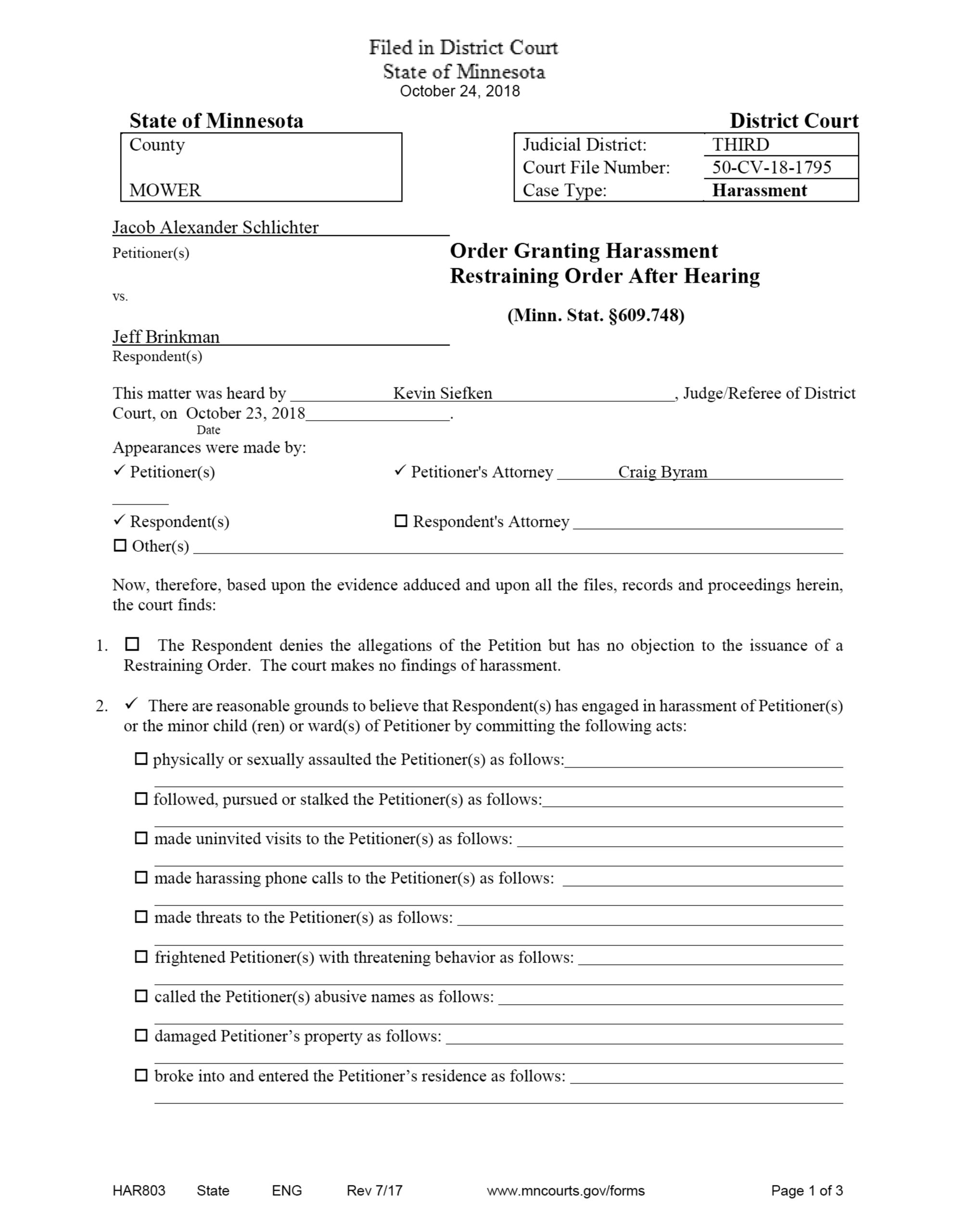
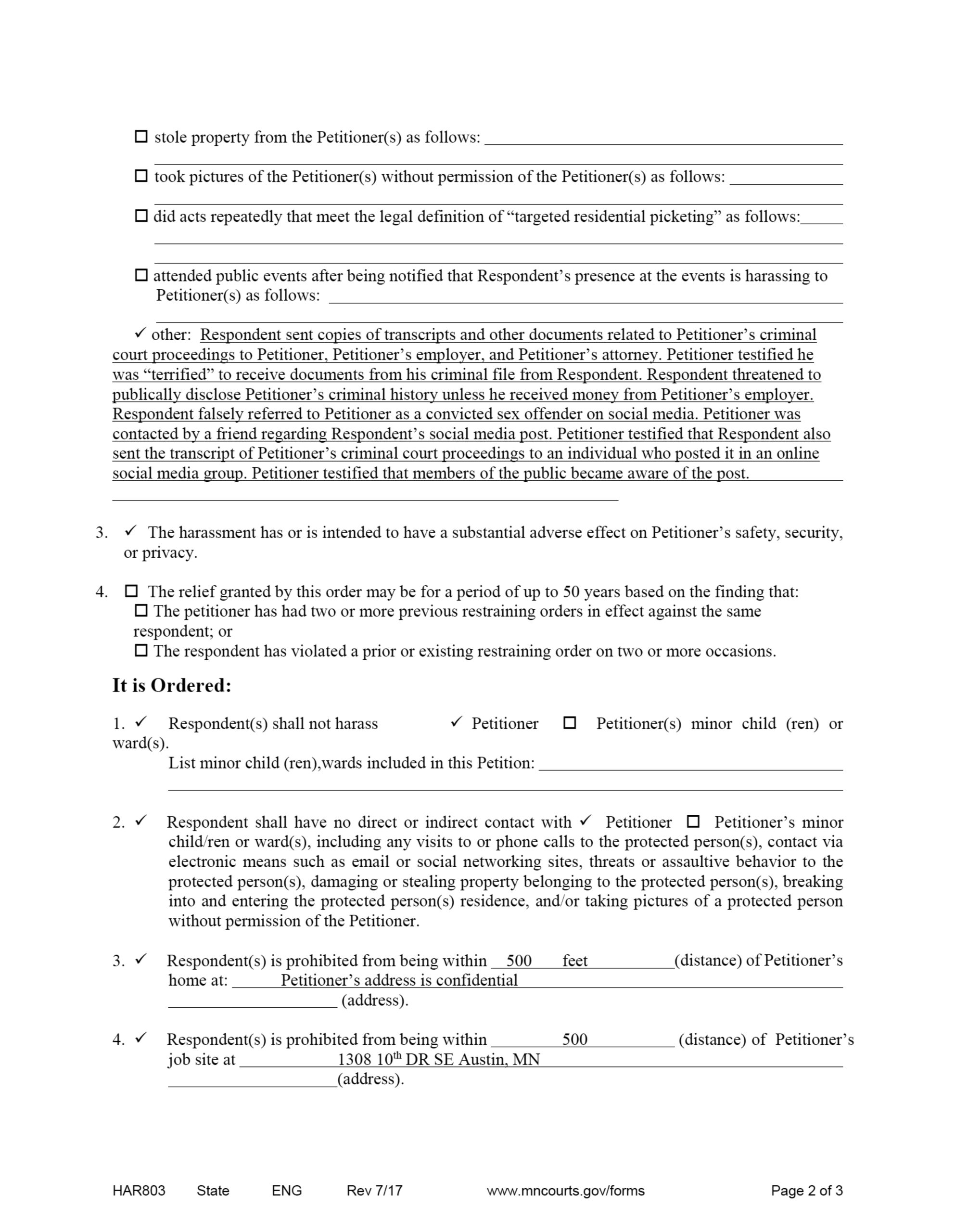
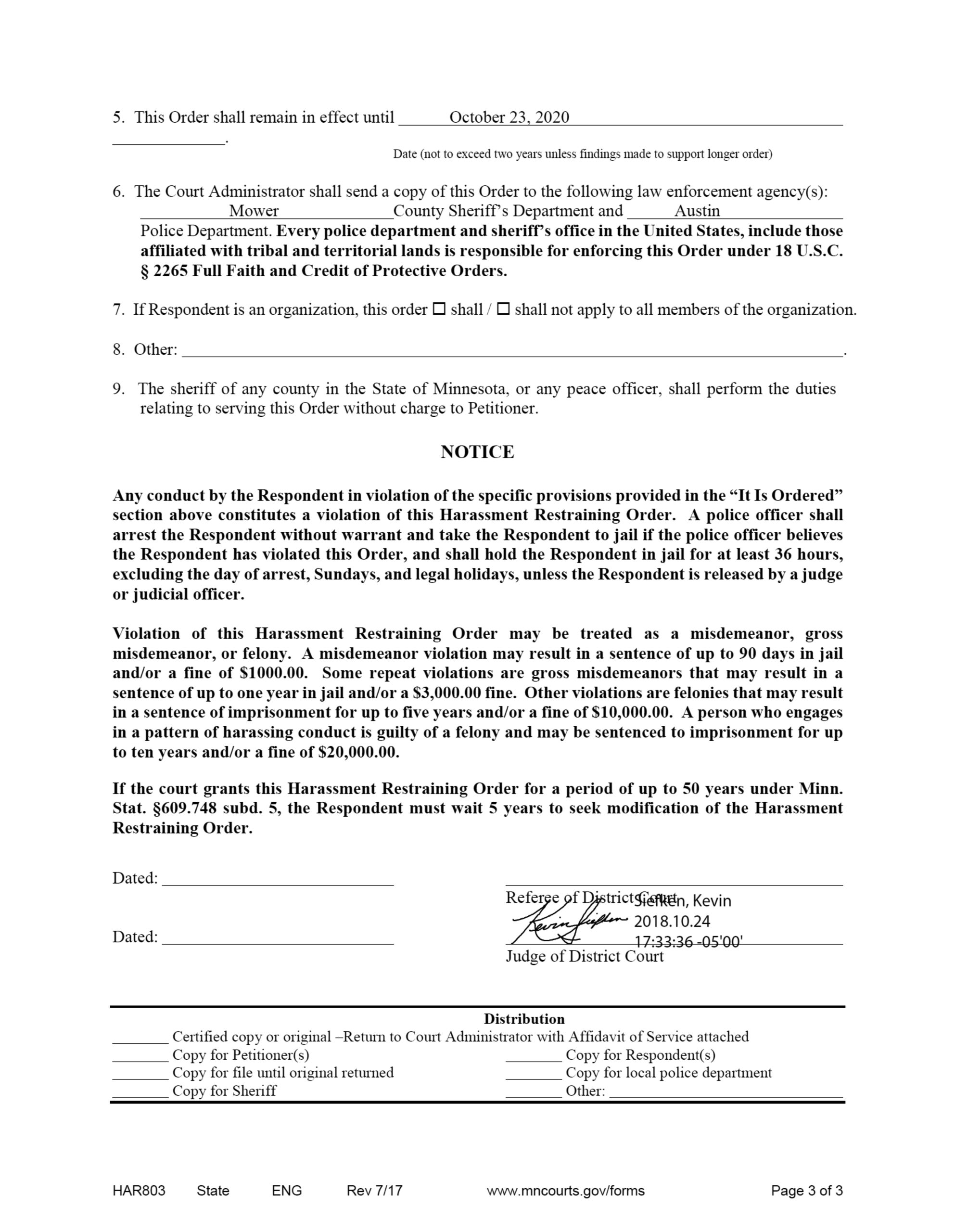
50-CV-18-1795 – 01
50-CV-18-1795 – 02
50-CV-18-1795 – 03
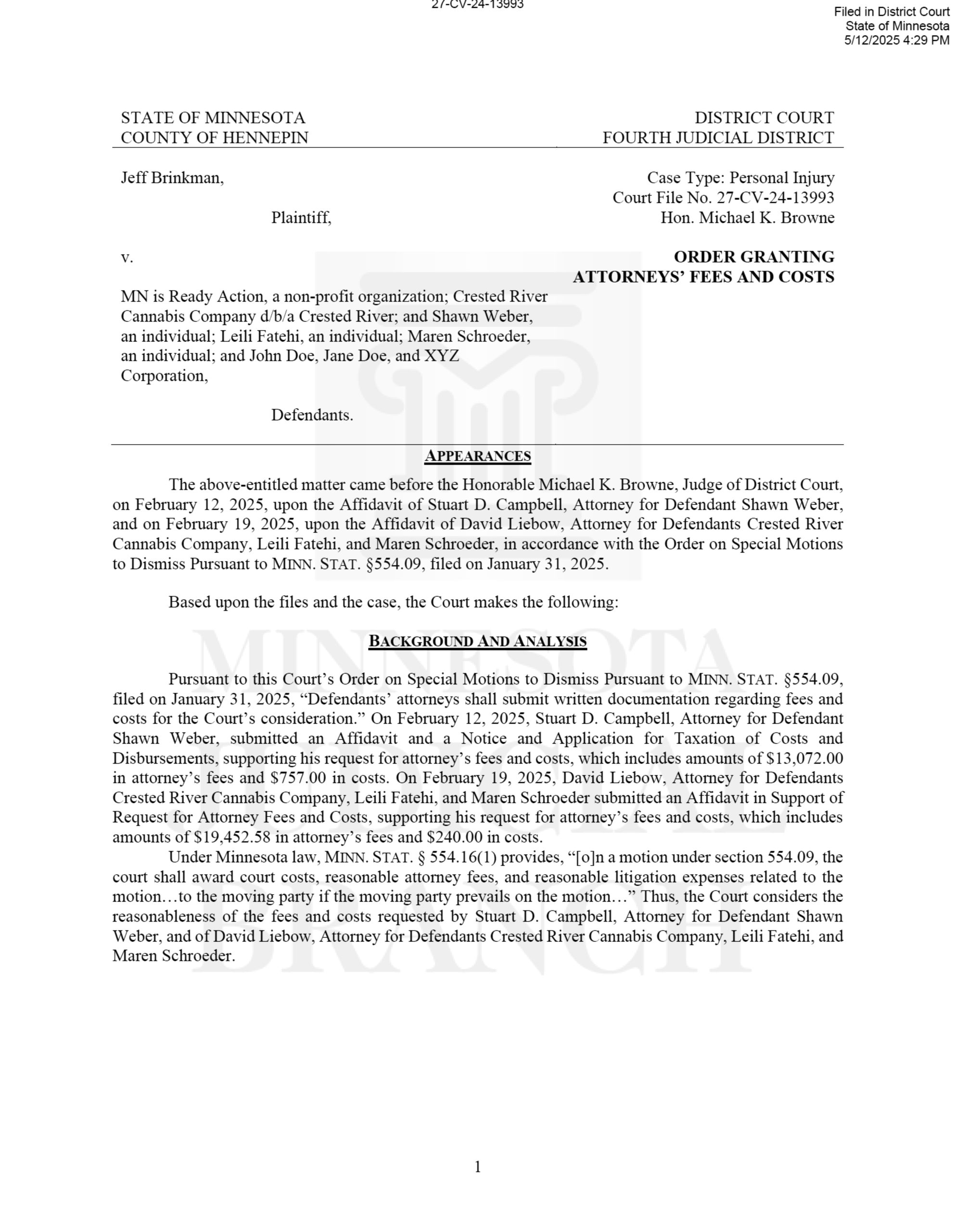
27-CV-24-13993 – 01
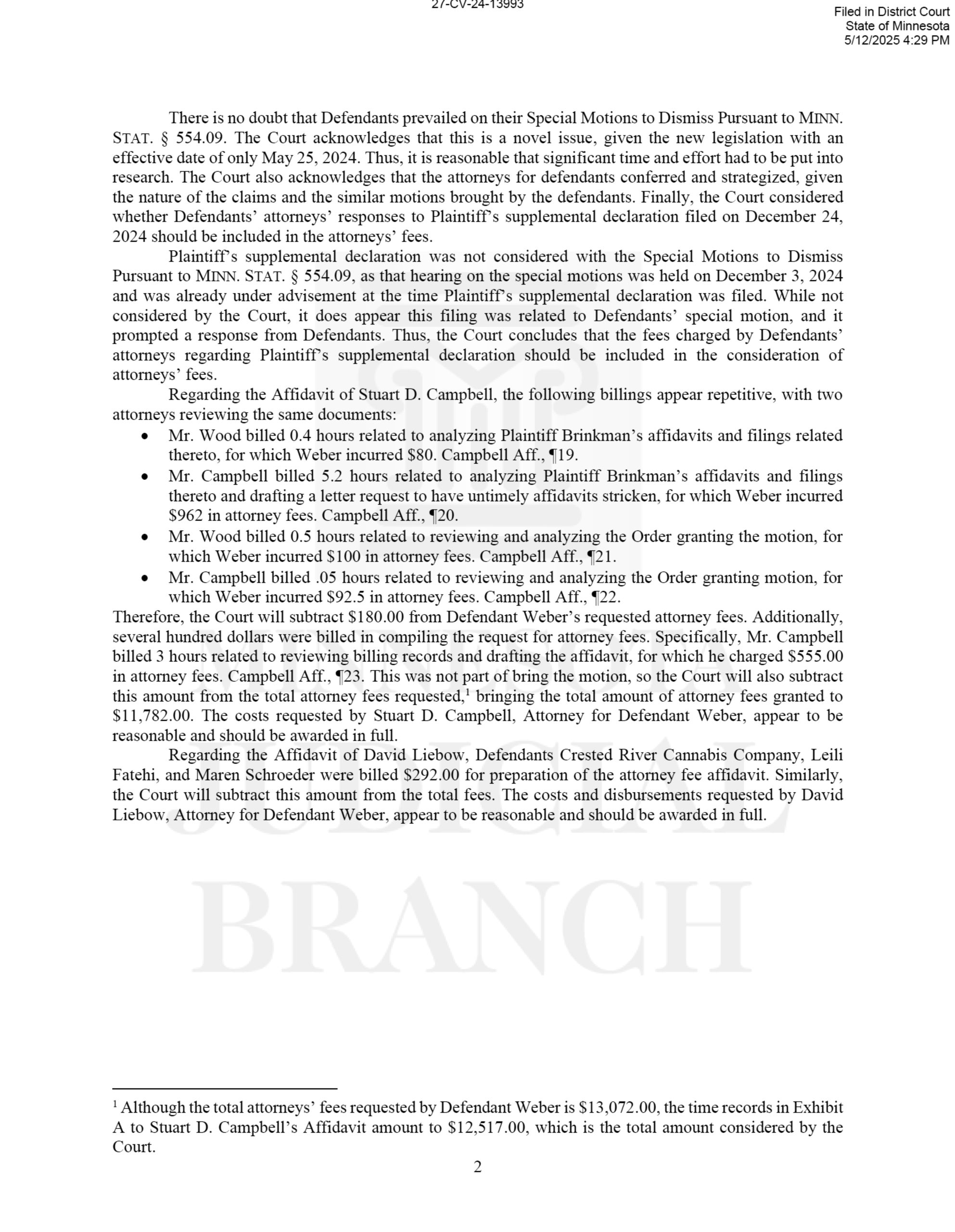
27-CV-24-13993 – 02
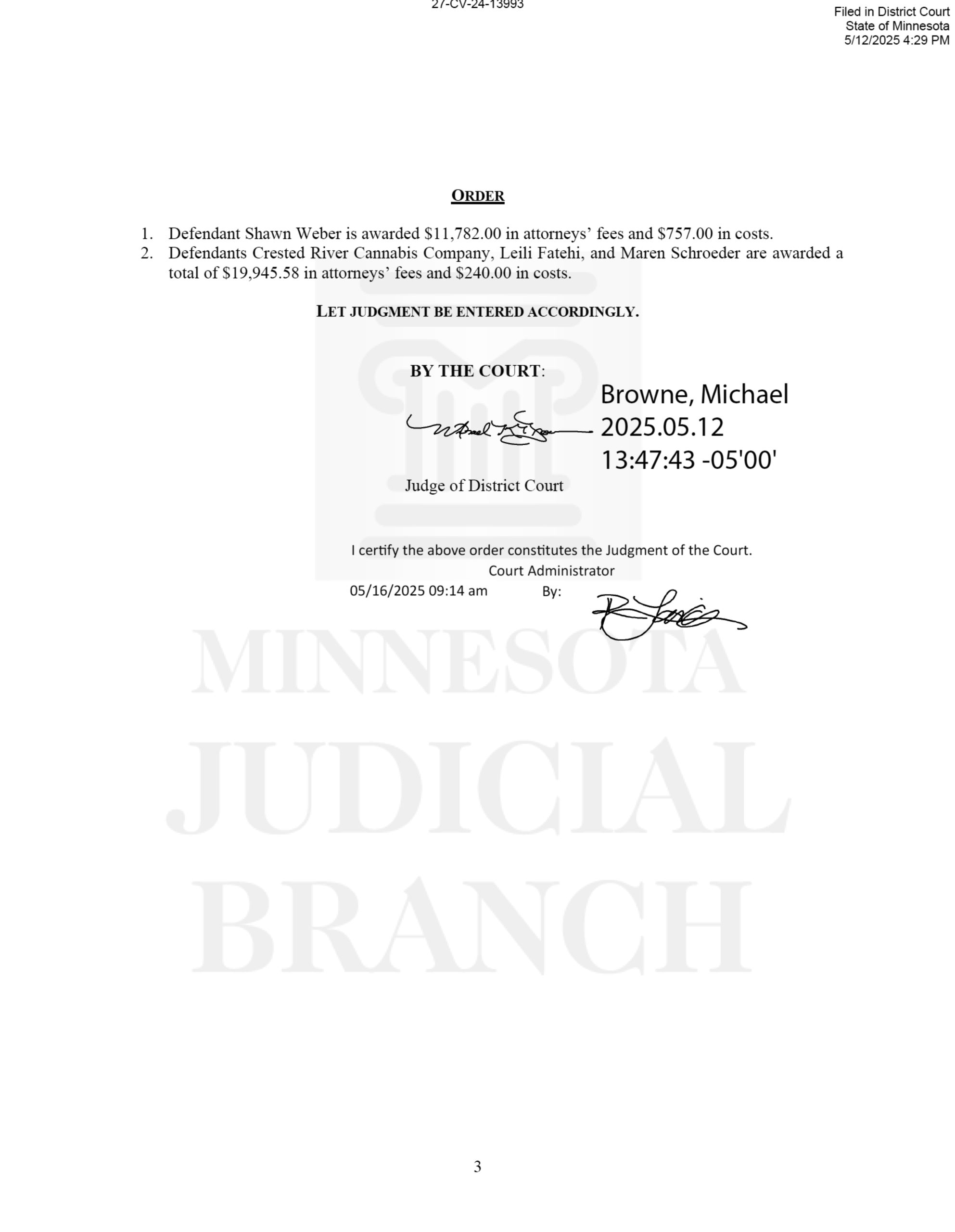
27-CV-24-13993 – 03
(Above: Hennepin County Court File 27-CV-24-13993, the Judgement against Jeffrey Robert Brinkman)
How Did an Expunged Record Reach a Competitor?
Records from Schlichter’s expunged case were only obtained by his attorney in 2018, and we verified this info with the original court reporter involved.
There is no evidence establishing that Brinkman obtained the records through a lawful public-records process. Yet, Schlichter obtained a Restraining Order against Brinkman for his dissemination of these records.
That creates an important question:
How did an expunged legal record reach a competing cannabis business owner and become part of a municipal licensing dispute?
If Brinkman obtained authentic records improperly, that raises legal and ethical questions.
If he did not obtain the original records, then the authenticity and provenance of the documents being circulated become equally important questions.
Screenshots, photographs, reproductions, or digitally generated documents should not be treated as official records without verification.
Jeffrey Robert Brinkman: A Competing Business Owner
Jeffrey Robert Brinkman, owner of Superior Cannabis Company, is not an Albert Lea resident. He lives in Austin, Minnesota.
His daughter, Abbigail Lynn Brinkman, lives in Duluth, Minnesota, roughly five hours from Albert Lea. These locations have been verified through court records and publicly available information.
Neither Brinkman nor his daughter is an Albert Lea resident, yet their allegations became part of the controversy surrounding Schlichter’s Albert Lea cannabis application.
Brinkman also has a documented history of conflict with Schlichter.
A 2018 harassment restraining order documented allegations concerning statements Brinkman made about Schlichter, including falsely labeling him a sex offender.
Brinkman has also been involved in other disputes within Minnesota’s cannabis industry. In 2025, he lost a lawsuit involving other cannabis business owners and was ordered to pay more than $30,000 in legal fees to the opposing parties.
Brinkman was not a neutral observer. He was a competing cannabis business owner from another city with an existing history of stalking, harassing, and defaming Schlichter.
Brinkman’s Communications With the City
Brinkman’s involvement went beyond public statements.
His communications with the Albert Lea City Council became part of the administrative record.
According to Section H of the city’s appellate brief, Brinkman submitted an email containing Schlichter’s expunged legal history and additional allegations made by Brinkman and on behalf of his daughter.
That information was provided to officials deciding whether Schlichter’s competing cannabis business should receive a registration.
The question is therefore straightforward:
Why was a competing business owner from another city so involved in an Albert Lea licensing decision concerning a competitor?
Community Support and Outside Opposition
The administrative record contains substantial community support for Schlichter.
The City’s own record identifies only two dissenting voices, Brinkman and an anonymous account using the name “Charles King.”
That contrast raises questions about why allegations from individuals with personal or competitive interests were given weight in the licensing process.
Criticism should be examined—but so should the source, credibility, and accuracy of that criticism.
One-Sided Reporting and the Consequences
Several reports concerning Schlichter’s past were published without meaningful comment from Schlichter or his legal representatives.
That is particularly significant when reporting involves:
-
a matter more than a decade old;
-
an expunged record;
-
events from Schlichter’s youth;
-
an exonerated charge; and
-
allegations that were not supported by evidence showing Schlichter participated in the underlying conduct.
Schlichter has reported public hostility, threats, disruption, and reputational damage following the publication and circulation of these allegations.
Once an accusation spreads, the surrounding context can disappear.
The legal outcome can disappear.
And the exoneration can disappear.
Cease-and-Desist Notices and Legal Action
Schlichter’s legal team has issued cease-and-desist notices to multiple individuals and media organizations, including Abbigail Lynn Brinkman, Jeffrey Robert Brinkman, The Albert Lea Tribune, Alpha News, and others.
The notices characterize certain statements and reporting as defamatory.
Those notices represent Schlichter’s legal position and are not themselves judicial findings, but they demonstrate the seriousness of the dispute.
(Below: An example of a Cease and Desist sent to Abbigail Lynn Brinkman.)
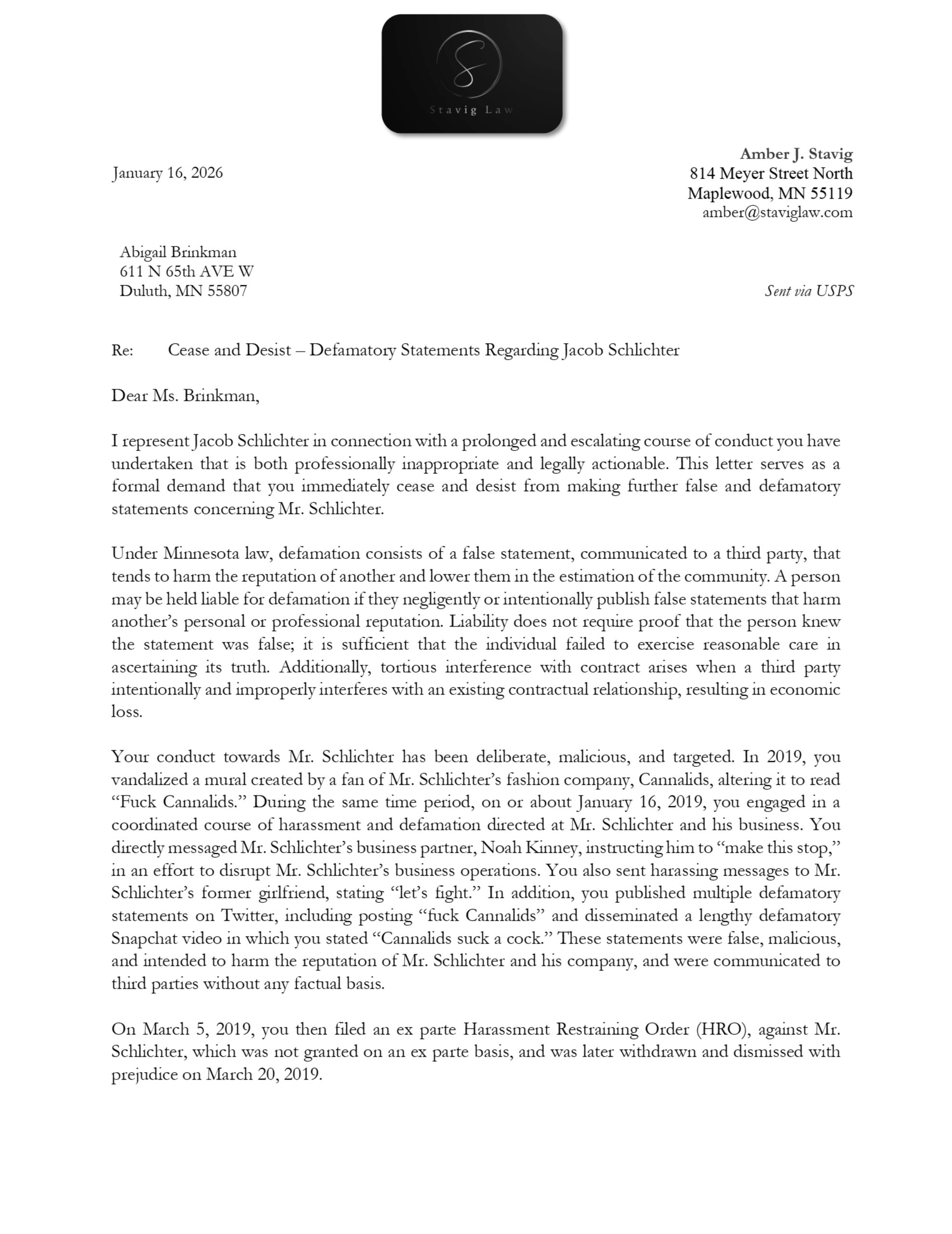
Abbigail Brinkman Cease and Desist – 01
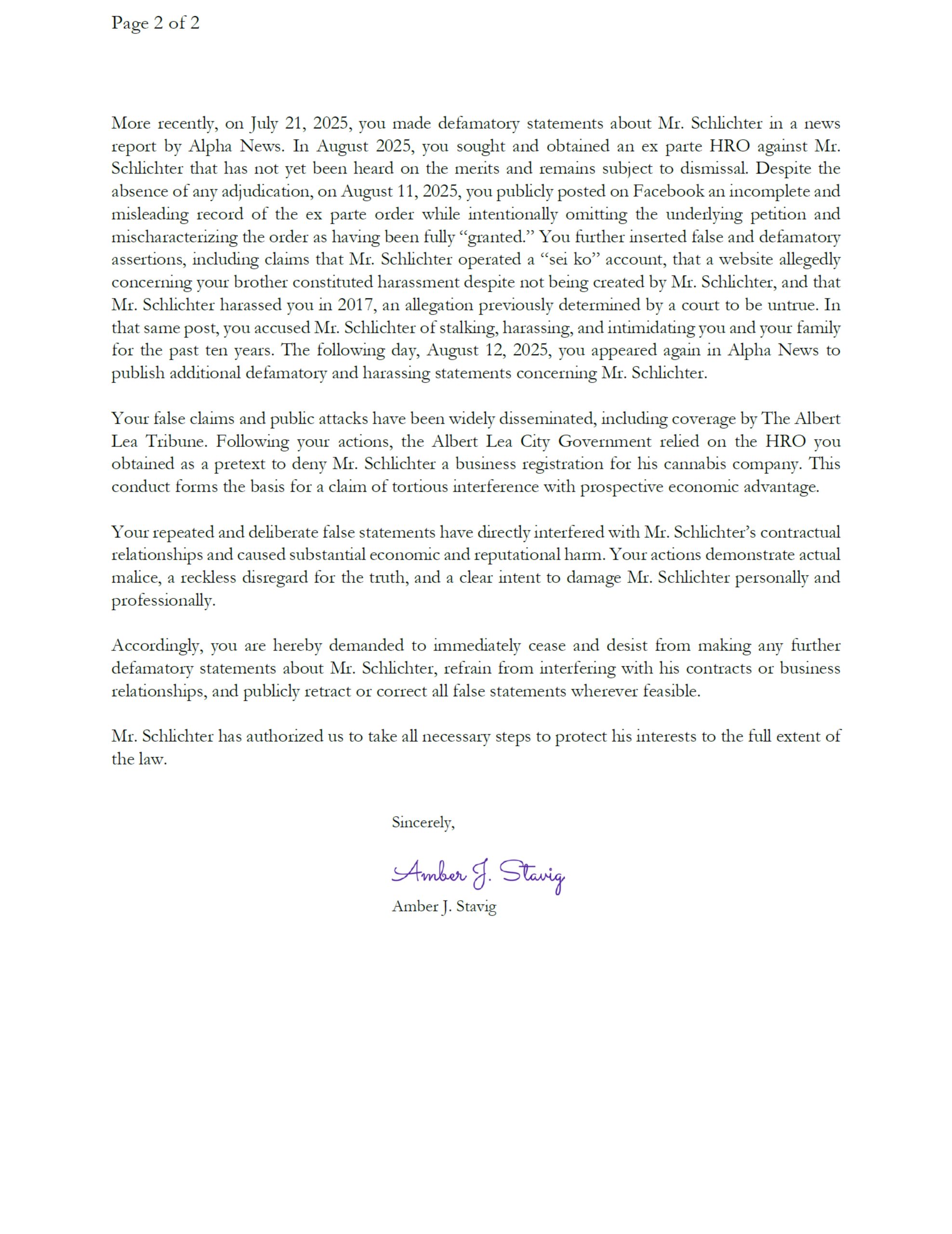
Abbigail Brinkman Cease and Desist – 02
*NOTE: As of February 2026, St. Louis County court transcripts indicate that Abbigail Lynn Brinkman admitted in court that she filed her HRO petition against Jacob Schlichter without conducting any research, relying solely on her personal opinions. She also stated that she expected the police and journalists to have verified the facts. These transcripts suggest that Ms. Brinkman may have filed a frivolous HRO and submitted a false police report against Mr. Schlichter, contributing to the defamatory coverage and public harassment he has endured.
Conclusion: Ethical Journalism Matters
Jacob Schlichter’s story illustrates why journalism must be fair, accurate, and complete.
A decade-old matter from someone’s youth should not become a permanent label—particularly when the record was previously expunged and the charge has since been exonerated.
The public deserves the complete timeline.
Schlichter and the individual involved knew each other while both were in high school. Both had dated other people before eventually dating each other. The individual involved accepted responsibility for her own role, while the evidence does not establish that Schlichter participated in the conduct underlying the original charge.
Those facts matter when evaluating later claims about their relationship.
So do the legal facts:
-
The charge has been exonerated.
-
The record was previously expunged.
-
Schlichter’s current record is clean.
-
He passed the background screening required for Minnesota cannabis licensing.
-
The prosecutor and probation officer stated Schlichter did not violate probation.
-
The individual involved stated that traveling to Minnesota was her decision and that she was safe.
-
Schlichter suffered a traumatic brain injury around the time of the events and was unable to assert his innocence.
-
Minnesota law contains close-in-age provisions addressing certain consensual relationships.
-
The evidence does not establish that Schlichter participated in the conduct underlying the original allegations.
-
Schlichter has not reoffended.
An allegation is not proof.
An expunged record is not a current conviction.
And an exonerated charge should not be presented as though the original accusation remains an established fact.
Responsible journalism requires verifying records, seeking responses, reporting legal outcomes, and distinguishing allegations from established facts.
In Schlichter’s case, the complete record tells a considerably more complicated story than the headlines suggest.
UPDATE — May 2026
The following developments occurred after the original January 20, 2026 publication.
Minnesota Court of Appeals Reverses Albert Lea
On May 18, 2026, the Minnesota Court of Appeals reversed Albert Lea’s denial of Schlichter’s cannabis registration, finding the city’s decision “contrary to law” and “arbitrary.”
The court found that Schlichter’s application met the requirements of the city’s ordinance in effect when he applied. City staff had determined the application was complete and compliant, and the court found that no councilmember identified a deficiency in Schlichter’s application or a reason specific to his suitability during the July 28 vote.
The court also held that the July 28 vote was the city’s final decision on the application. The city’s later characterization of the vote as merely a “pause” was not supported by the record.
The appellate court did not order Albert Lea to immediately issue Schlichter a registration. It ruled that the city’s July 28 denial could not be sustained and left questions about the city’s amended ordinance unresolved.
Albert Lea Changed Its Cannabis Ordinance
While the case was pending, Albert Lea amended its cannabis ordinance, increasing the number of available registrations and adding additional evaluation criteria.
The appellate court acknowledged the change but did not decide whether Schlichter’s application should ultimately be evaluated under the amended ordinance.
Second HRO Granted Against Brinkman
After the original publication, Schlichter was granted a second harassment restraining order against Jeffrey Robert Brinkman.
The order followed Brinkman’s dissemination of unproven claims about Schlichter, which the Judge’s findings stated were being used to generate public outrage against him.
Additionally, the judge found that Brinkman had a vendetta against Schlichter.
This later court action provides additional context to the continuing dispute between Brinkman and Schlichter and is separate from the events described in the original January 20 article.