
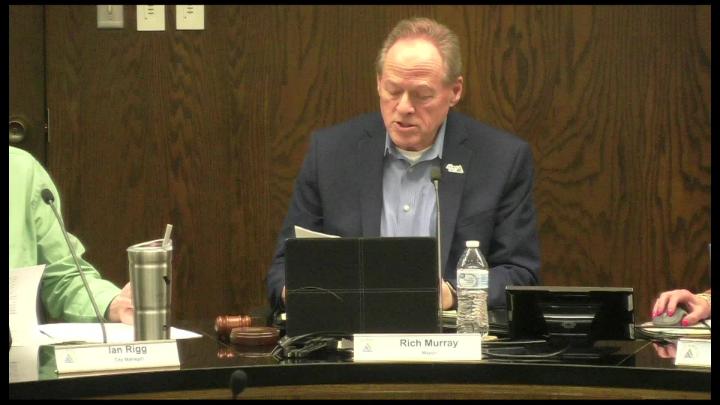
(Photo: Albert Lea City Council)
Albert Lea, MN — May 23, 2026
Court of Appeals reverses Albert Lea cannabis denial, finds city acted “contrary to law” and “arbitrary”
The Minnesota Court of Appeals has reversed the City of Albert Lea’s denial of a cannabis retail registration for The Smoking Tree LLC, owned by Jacob Schlichter, holding that the city’s decision violated its own ordinance and was “contrary to law” and “arbitrary.”
The ruling marks a significant rebuke of how the City Council, including Mayor Rich Murray and councilmembers Larry Baker, Rachel Christensen, and Keith Van Beek, handled the city’s first cannabis licensing decision under Minnesota’s new statewide framework.
City denied fully compliant application despite staff approval
Schlichter submitted his application on July 17, 2025, the same day he received state licensing approval from the Minnesota Office of Cannabis Management.
At the time, Albert Lea’s ordinance required cannabis registrations to be issued on a strict first-come, first-served basis tied to a timestamped state license.
City staff reviewed the application, determined it was complete, and confirmed it met all ordinance requirements before forwarding it to the City Council.
Despite that, the City Council voted 4–3 to deny the application on July 28, 2025.
Councilmembers voting against approval were:
- Mayor Rich Murray
- Councilmember Larry Baker
- Councilmember Rachel Christensen
- Councilmember Keith Van Beek
Court: city was not allowed to ignore its own ordinance
The Court of Appeals made clear that once the city adopted its first-come, first-served system, it was legally bound to apply it.
The court stated:
“But once the city enacted that policy into law, the council was not free to disregard it.”
The court found no deficiency in Schlichter’s application and no lawful basis for denial under the ordinance in effect at the time.
Instead, the decision was based on considerations outside the governing criteria.
Record shows opposition to cannabis, not application defects
The appellate opinion found that council discussion focused largely on disagreement with cannabis legalization itself rather than any issue with the application.
Mayor Rich Murray was quoted in the opinion stating:
“I have not been a fan of this since the subject first came up a year ago. It seems like just two years ago we were locking people up for . . . smoking cannabis. And now we’re promoting it.”
The court cited remarks like these as evidence that the denial reflected policy disagreement rather than application-specific evaluation under the ordinance.
No councilmember identified a defect in the application during the vote.
It must be said that the Council and Mayor are public servants meant to enforce state law, not oppose it. Any citizen acting with such a blatant disregard for the law would be arrested. It should be no different for elected officials found to be acting both arbitrarily and contrary to law.
City later offered justification not part of the legal record
Following the ruling, City Manager Patrick Ian Rigg told the Star Tribune that the application had been rejected because it would not “protect the public health, safety, and welfare of the city residents,” citing ordinance language.
However, the Court of Appeals did not consider that explanation in reviewing the case, because it was not part of a formal motion or decision during the July 28 vote. Many critics considered Patrick Rigg’s comments at the latter City Council meeting nothing short of defamatory and a post hoc rationalization.
The court limited its review to the actual decision made at the July 28th meeting, not later bad-faith explanations offered afterward.
Court finds denial “contrary to law” and “arbitrary”
The Court of Appeals concluded:
- The Smoking Tree met all requirements of the ordinance
- City staff confirmed compliance
- No legal deficiency was identified at the time of the vote
- The denial was based on considerations outside the ordinance
Based on those findings, the court held the decision was both “contrary to law” and “arbitrary.”
Ordinance changes during litigation
While in the midst of litigation, the city of Albert Lea amended its cannabis ordinance in February 2026 to expand the number of available registrations and add broader evaluation criteria. These criteria include background checks and discretionary review factors, such as giving itself authority over the sale of a business and verifying if a business has a supply.
Those changes occurred while litigation was ongoing, raising questions about how the city’s original framework was applied versus how it was later revised. Shortly after the ordinance was updated, the City voted on two more cannabis stores. At no point in this process did the City reconsider The Smoking Tree.
Critics debate the legality and ethics of such changes. Can the City implement new criteria and then enforce that on an applicant who applied under the old criteria? Is a City allowed to approve four stores but deny their first? Was the changing of the ordinance in good faith or part of a more nefarious attempt at discriminating against Schlichter? These are just a few of the questions on everybody’s minds.
Broader legal significance
Although the decision is nonprecedential, it is the first appellate interpretation of Minnesota’s cannabis regulatory system under Chapter 342.
The ruling reinforces a basic principle: when a city adopts clear rules governing licensing decisions, it must follow them as written.
The Court of Appeals concluded that Albert Lea did not do so in this case.
Outcome
The Court reversed the city’s denial of The Smoking Tree’s application.
This has left a permanent stain on the City of Albert Lea, more specifically, Mayor Richard Murray and councilmembers Larry Baker, Rachel Christensen, and Keith Van Beek.
Many of these disgraced City officials are up for reelection.