
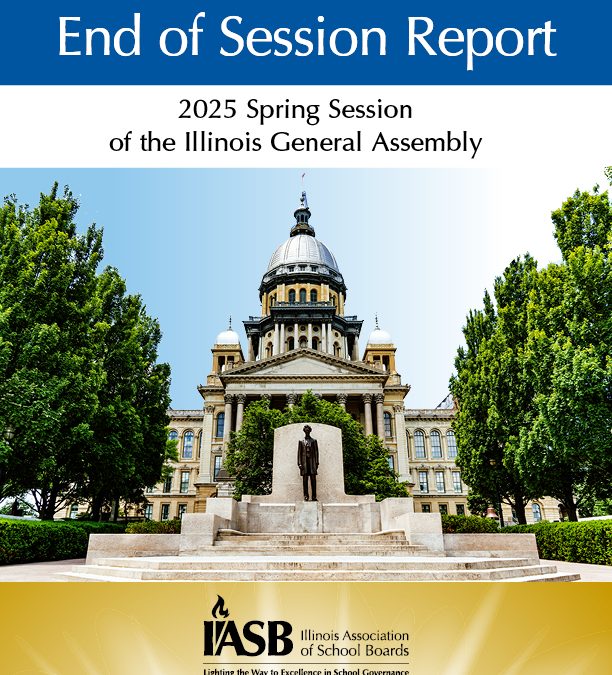
(Photo: IASB)
Springfield, Illinois — June 1, 2025
The Illinois General Assembly concluded its 2025 spring session with several significant actions affecting K–12 education funding, including allocations for Evidence-Based Funding, mandated categorical programs, and targeted initiatives in STEM, arts, and career readiness. Lawmakers approved the FY 2026 state budget, providing clarity on how education resources will be distributed to districts statewide, including those in the Great Lakes region of Illinois.
Evidence-Based Funding Increases
The FY 2026 budget allocates $8.9 billion to the Evidence-Based Funding (EBF) formula, an increase of $307 million over FY 2025. While this continues Illinois’ efforts to direct more resources to high-need districts, it falls slightly short of the statutory $350 million annual target, a shortfall addressed in part by adjustments to the Property Tax Relief Grant. (IASB End-of-Session Report, August 2025)
EBF remains the primary tool for equitably distributing state education dollars, ensuring that districts serving students with greater needs receive additional support.
Mandated Categorical Programs (MCATs)
Several Mandated Categorical programs were maintained at FY 2025 levels, including:
-
Regular Transportation
-
Special Education Transportation
-
Special Education Private Facilities
Because statewide claims exceeded the flat funding, many districts will experience higher proration, requiring local budgets to cover a larger share of program costs.
Two categorical programs — Special Education Orphanage and Regular Education Orphanage — received a $20 million increase to bring funding to statutory levels. (IASB End-of-Session Report, August 2025)
Targeted Program Investments
The FY 2026 budget also provides focused support for programs aimed at enhancing student learning and workforce readiness:
-
After-School Programs: $35 million to expand enrichment opportunities beyond the classroom
-
Career and Technical Education (CTE): $59.3 million to strengthen vocational programs and workforce readiness
-
Computer Science Equity Grants: $3 million to increase access to coding and technology instruction
-
Comprehensive Literacy Program: $1.5 million to support literacy and numeracy initiatives
-
Teacher Recruitment: Ongoing funding for scholarship and incentive programs, including Minority Teachers of Illinois and Golden Apple scholarships (IASB End-of-Session Report, August 2025)
Teacher Vacancy Pilot Program
The Teacher Vacancy Pilot Program received $30 million, marking a decrease from previous fiscal years. The program aims to address teacher shortages across Illinois, particularly in districts struggling to attract qualified educators.
Community and Educator Reactions
School administrators welcomed the continued investment in EBF and targeted programs but noted that proration of categorical programs may pose challenges for some districts.
“While funding increases are a step in the right direction, districts with high transportation and special education costs will still need to navigate proration and local budget shortfalls,” said Susan Furlong, a representative from the Illinois Association of School Boards. “The new budget gives districts more flexibility but also highlights areas where additional support is still needed.”
Parents and teachers in the Great Lakes region of Illinois, including cities like Chicago, Waukegan, and Rockford, expressed cautious optimism. The expanded after-school and career-technical programs are expected to benefit thousands of students, helping to prepare them for college and career opportunities.
Looking Ahead
As FY 2026 begins, school districts will finalize plans for distributing these funds. Lawmakers and education advocates continue to discuss long-term strategies to address proration challenges, teacher recruitment, and expanding access to STEM and arts programs.
“This budget reflects a commitment to keeping Illinois schools competitive and ensuring students across the state, including those near the Great Lakes, have access to high-quality education,” said State Senator Laura Murphy. “There is more work ahead, but this session lays an important foundation.”